

Wedge Pattern on Quotex — Reversal Setups
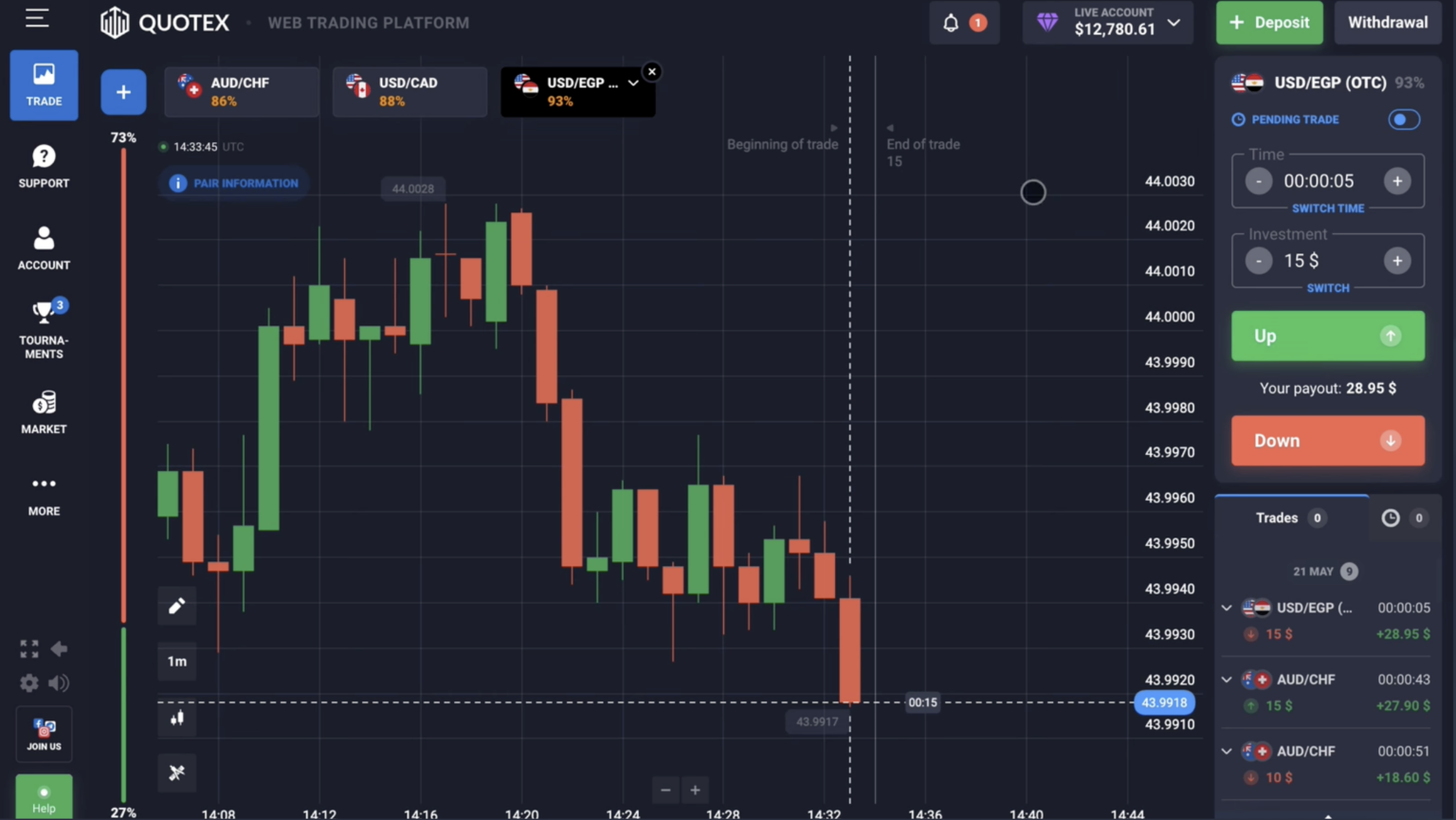
Two Wedge Variants
| Variant | Top Line Slope | Bottom Line Slope | Reversal Direction |
|---|---|---|---|
| Rising Wedge | Up (steeper) | Up (less steep) | Bearish reversal typically |
| Falling Wedge | Down (less steep) | Down (steeper) | Bullish reversal typically |
Why Wedges Reverse
Rising wedge: both lines slope up but bottom line slopes steeper than top. This means: highs are still rising, but lows are rising even faster. Buyers are losing relative strength to sellers (sellers preventing higher highs while buyers struggle to support new lows). Eventually buyers exhausted; sellers break the lower trendline = bearish reversal. Falling wedge: both lines slope down but top is less steep than bottom. Sellers losing power vs buyers; eventually buyers overpower.
Wedge Identification
- Rule 1 — Both trendlines slope in same direction
- Rule 2 — Lines converging (will eventually meet)
- Rule 3 — At least 4-5 touches confirming each line
- Rule 4 — Volume typically declining during wedge formation
- Rule 5 — Pattern duration: 30-80 candles typical
Entry Rules
- Step 1 — Identify wedge with clear trendlines and touches
- Step 2 — Wait for breakout in REVERSAL direction (NOT continuation)
- Step 3 — Breakout must be confirmed by candle close beyond trendline
- Step 4 — Volume increase on breakout adds confidence
- Step 5 — Enter on next candle after breakout
- Step 6 — Expiry: 2-3× chart timeframe
Wedge vs Triangle Comparison
Distinct pattern families with different implications:
| Aspect | Wedge | Triangle |
|---|---|---|
| Trendline slopes | Both same direction | Opposite (one flat or one each direction) |
| Typical resolution | Reversal (opposite of slope direction) | Continuation OR breakout direction-neutral |
| Reliability | Slightly higher reversal win rate | Continuation often more reliable |
| Identification | Subtle (slopes can vary) | More obvious (clear flat or opposite slopes) |
Wedge FAQ
Are wedges more reliable than triangles?
For reversal trading: yes. Wedges have ~65-70% win rate for reversal breakouts when properly identified. Triangles have ~55-60% reversal rate (often continue instead). The 'same-direction slope' nature of wedges is structurally bearish/bullish based on the slope dynamics.
What's the difference between wedge and channel?
Channel has PARALLEL trendlines (both slope same direction at same rate). Wedge has CONVERGING trendlines (slope same direction but different rates). Channels typically signal continuation; wedges signal reversal.
How long does a typical wedge take to form?
30-80 candles. Shorter wedges (under 30 candles) often fail or are misidentified. Longer wedges (over 100 candles) are very reliable when they finally break.
Do wedges always reverse?
Most do (65-70% reverse) but not all. About 30% continue in slope direction — pattern fails. Use confirmation: breakout candle close, volume increase, confluence with S/R levels for highest reliability.
Can rising wedge break upward instead of bearishly?
Yes — pattern failure. Happens about 25-30% of the time. Indicates strong underlying buying pressure overcame the wedge's bearish structure. Cut the trade if you entered on bearish bias.
Best timeframe for wedge trading?
1h-4h timeframes for binary options. 5m wedges are noisy; daily wedges have too few setups. 1h gives 5-10 wedge setups per week across major assets.
Quotex
Disclosure: Sign-up links on this page may earn us a commission at no extra cost to you. This does not affect the editorial accuracy of our content — payouts, methods, and platform features are reported as observed.