

Morning & Evening Star Patterns on Quotex
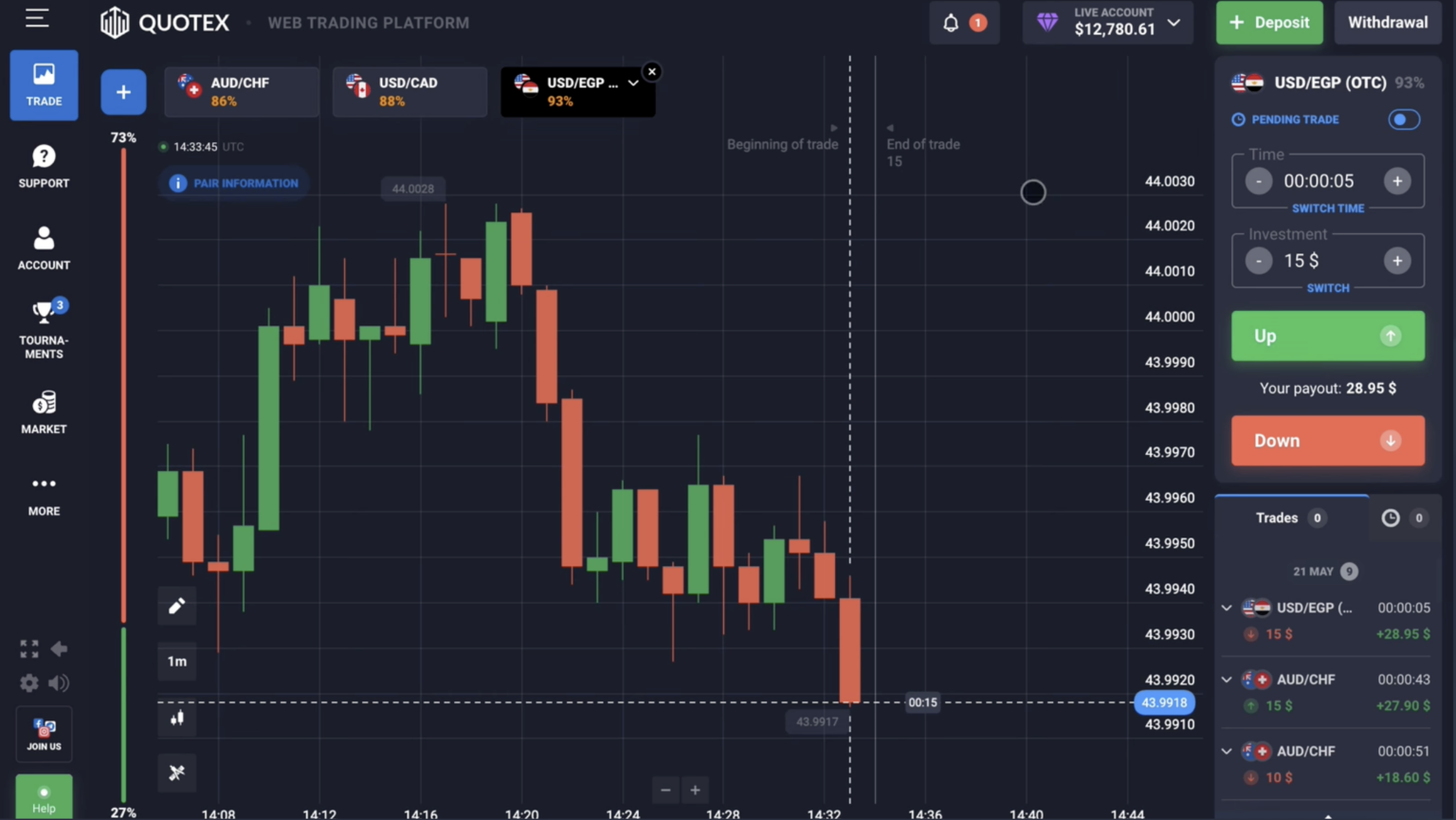
Morning Star Anatomy (Bullish)
Morning Star forms at the BOTTOM of a downtrend across three candles:
- Candle 1 — Large bearish candle (red) continuing the downtrend — sellers in control
- Candle 2 — Small-body candle (any color, often Doji) — momentum exhaustion; gap down typically
- Candle 3 — Large bullish candle (green) closing well into Candle 1's range — buyers taking control
- Together: down → indecision → up = trend reversal evidence
Evening Star Anatomy (Bearish)
Evening Star is the mirror — forms at the TOP of uptrend:
- Candle 1 — Large bullish candle (green) — buyers in control
- Candle 2 — Small-body candle — momentum exhaustion; gap up typically
- Candle 3 — Large bearish candle (red) closing well into Candle 1's range — sellers taking control
- Together: up → indecision → down = trend reversal evidence
Identification Rules
- Rule 1 — Pattern must occur after sustained trend (not in range or after just 2-3 candles)
- Rule 2 — Candle 1 must be large (≥1× ATR of recent average)
- Rule 3 — Candle 2 must be small-body (body ≤30% of Candle 1 body)
- Rule 4 — Candle 3 must close ≥50% into Candle 1's range
- Rule 5 — Pattern strongest at established S/R level
Entry Rules
- Step 1 — Identify all 3 candles meeting anatomy rules
- Step 2 — Wait for Candle 3 to CLOSE
- Step 3 — Enter on Candle 4 open in reversal direction (CALL for Morning Star, PUT for Evening Star)
- Step 4 — Expiry: 2-3× the chart timeframe (give the reversal time to develop)
- Step 5 — Combined with S/R confluence or RSI extreme — highest probability setup
Morning/Evening Star Reliability
| Setup | Win Rate | Net Result per 100 trades (85% payout) |
|---|---|---|
| Star pattern alone, weak trend | 55% | -$8 |
| Star at clear S/R level | 62% | +$132 |
| Star at S/R + RSI extreme | 67% | +$202 |
| Star at multi-timeframe S/R + RSI + recent strong trend | 71% | +$278 |
Three Worked Examples
- Example 1 — EUR/USD 15m, May 9 2026: Morning Star at 1.0810 support after 12-hour downtrend. Candle 1 large red, Candle 2 small Doji, Candle 3 large green closing at 1.0848. Entered CALL on Candle 4 (1.0852) with 1h expiry. Exit 1.0890 → WIN, +$21 on $25 stake.
- Example 2 — BTC/USD 1h, May 11 2026: Evening Star at $62,600 resistance + RSI 78. Three-candle pattern textbook clean. Entered PUT 3h expiry. Exit $61,400 → WIN, +$21.
- Example 3 — Gold 15m, May 14 2026: tried Morning Star at $2,330 but Candle 3 only closed 30% into Candle 1's range (rule 4 violated). Entered CALL anyway. Pattern wasn't strong enough; price continued lower. Exit at LOSS, -$25. Lesson: strict rule adherence matters; weak patterns produce poor win rates.
Star Pattern FAQ
Are Morning/Evening Star better than 2-candle patterns?
Slightly better — the 3-candle structure provides built-in confirmation (Candle 3 confirms reversal). Engulfing patterns can fail because the 'reversal candle' was an isolated reaction. Star patterns are unlikely to be isolated reactions because the structure shows progression from old trend through indecision to new trend.
Does Candle 2 need to gap?
Traditional Japanese candlestick definition: yes — gap between Candle 1 and Candle 2, and again between Candle 2 and Candle 3. In modern 24/7 markets (forex, crypto), true gaps are rare. Modified definition: Candle 2 should be clearly separated in price action even without explicit gap. Stricter modern test: Candle 2's body should not overlap significantly with Candle 1 or Candle 3 bodies.
What if Candle 2 is large?
Then it's NOT a Morning/Evening Star. The small Candle 2 is essential — it represents the 'indecision' transition between old trend and new. Large Candle 2 would indicate continued momentum, not exhaustion.
Should I always wait for Candle 3 confirmation?
Yes. Entering after Candle 2 (anticipating Star pattern) is too premature — many potential Stars fail at the 3rd candle. The 1-candle wait for confirmation significantly improves win rate.
Do these patterns work on cryptocurrency 24/7?
Yes, though true 'gap' definitions don't apply (crypto trades continuously). Use modified definition: Candle 2's body should be clearly small relative to Candles 1 and 3. BTC and ETH 15m-1h charts show clear Morning/Evening Star setups multiple times per week.
What's the best expiry for Star patterns?
2-3× chart timeframe. On 15m chart, use 30-45 min expiry. On 1h chart, use 2-3h expiry. The reversal often unfolds over multiple candles after the Star pattern completes — give time for that to develop. Very short expiries (5 min on 15m chart) often expire before the reversal fully materializes.
Quotex
Disclosure: Sign-up links on this page may earn us a commission at no extra cost to you. This does not affect the editorial accuracy of our content — payouts, methods, and platform features are reported as observed.