

Martingale Simulator for Binary Options
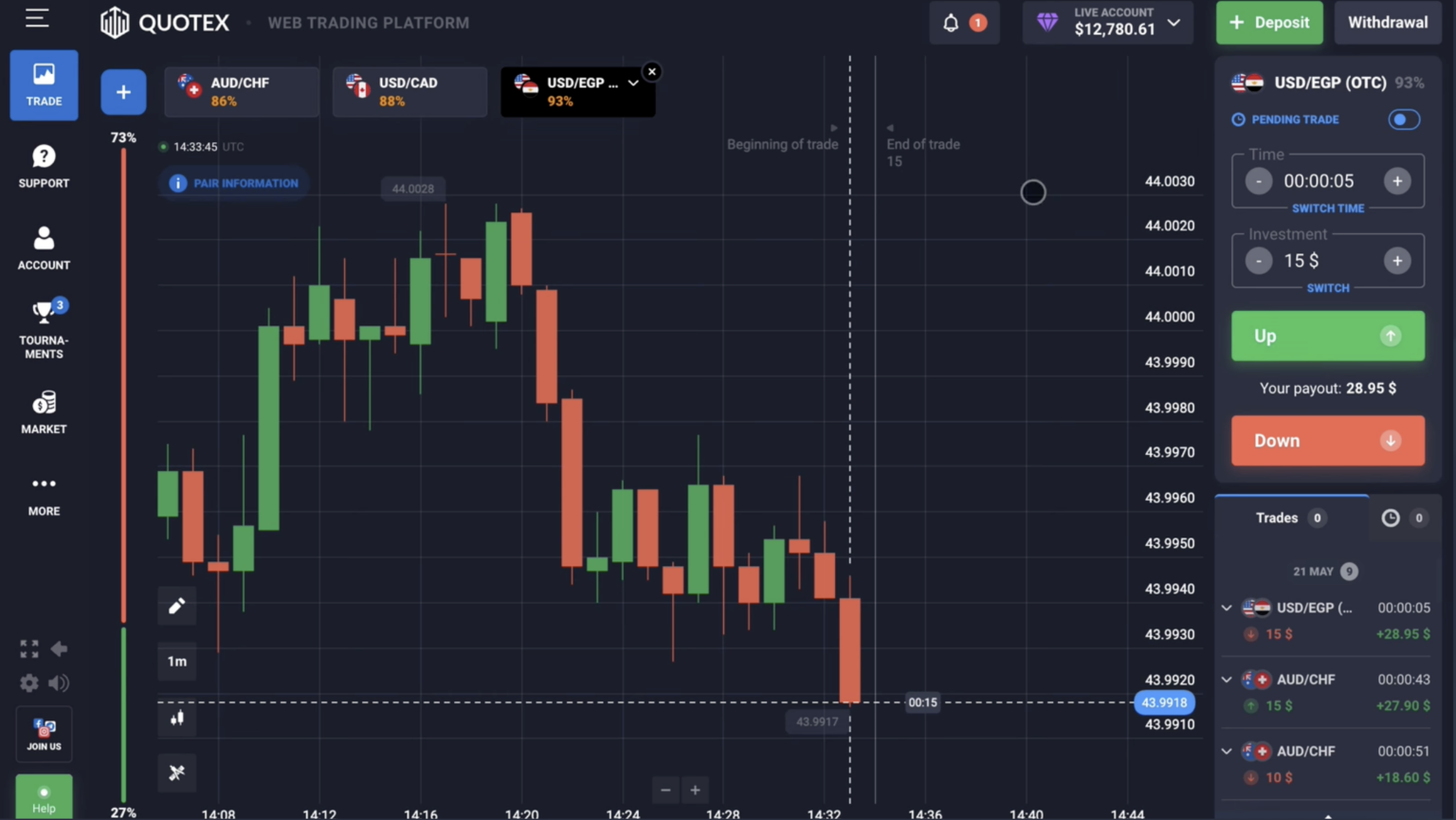
The Martingale Concept
Martingale logic: start with $10 stake. If you lose, next trade is $20. If lose again, $40. If lose again, $80. Eventually you win — and the winning trade recovers all prior losses plus your original $10 stake. Sounds bulletproof. The problem: this assumes you have unlimited capital, unlimited time, and a 100% payout. None of these are true on Quotex. Specifically: (1) capital is finite — you'll hit your account ceiling before the unlikely 8-loss streak resolves; (2) payouts are less than 100%, so the 'win recovers everything' math doesn't add up; (3) Quotex has maximum stake limits per trade.
The Math: Why It Fails at 85% Payout
Classical martingale assumes 1:1 payout (win exactly your stake). At 85% payout, you only win 0.85 × stake. So when you win, you recover less than the full prior losses. Watch the math: lose $10, lose $20, lose $40, win $80. Total bet: $150. Win recovers: $80 + 85% × $80 = $148. You're still down $2 despite 'winning the martingale.' This isn't a quirk — it's a fundamental mathematical fact about ratio of payout to stake.
| Trade # | Stake | Outcome | P/L This Trade | Cumulative P/L |
|---|---|---|---|---|
| 1 | $10 | LOSS | -$10.00 | -$10.00 |
| 2 | $20 | LOSS | -$20.00 | -$30.00 |
| 3 | $40 | LOSS | -$40.00 | -$70.00 |
| 4 | $80 | WIN at 85% payout | +$68.00 | -$2.00 |
| Net result | — | Won the 'martingale' | — | Still -$2 net loss |
Required Payout for Martingale to Work
For martingale to break even at the eventual win, you need: (Total stakes prior to win) ≤ (Payout on winning trade). At doubling stakes 1, 2, 4, 8 — total is 15. Winning trade of 8 at payout P needs 8 × P ≥ 15, so P ≥ 1.875 — i.e., 187.5% payout. Quotex never offers payouts that high (max is around 95%). Therefore: at any payout under 100%, martingale loses on average even with perfect entry timing.
The 'Lucky Streak' Risk
Worse: martingale users often experience 5-10 successful martingales before the catastrophic 7-loss streak. Each successful martingale gives a small net loss (-$2 in our example) but feels like a win because you 'recovered.' This trains you to keep using martingale, growing position sizes, until the inevitable 7-loss streak destroys 70%+ of the account in one stretch. Modal outcome: many small losses interspersed with catastrophic blow-up. Expected long-term outcome: account loss.
| Streak Length | Probability (at 55% win rate) | Total Stake by End | Capital Required |
|---|---|---|---|
| 3 losses | 9.1% | $70 (after $10 → $20 → $40 → $80) | $70 to continue |
| 5 losses | 1.8% | $310 | $310 |
| 6 losses | 0.83% | $630 | $630 |
| 7 losses | 0.37% | $1,270 | $1,270 |
| 8 losses | 0.17% | $2,550 | $2,550 |
| 9 losses | 0.075% | $5,110 | $5,110 |
| 10 losses | 0.034% | $10,230 | $10,230 |
Account Blow-Up Calculation
On a $1,000 account starting martingale at $10: a 7-loss streak requires $1,270 — you blow up at trade 7 with $20 left. A 6-loss streak requires $630 — you survive but lose 63% of account in one streak. Recovery requires 170% gain. Most traders abandon strategy or worse, deposit more money and continue (rarely ends well). Even at the relatively rare 6-loss streak (0.83% probability per attempt), if you martingale 100 times over a year, expected number of catastrophic streaks: ~1. The math says: martingale + 1 year = high probability of account-destroying drawdown.
Alternatives to Martingale
- Alternative 1 — Anti-martingale (double-up on WINS instead): captures winning streaks while limiting losses. Mathematically sound when you have positive edge.
- Alternative 2 — Fixed-fractional (the standard 1-2% rule): boring but mathematically optimal in the long run.
- Alternative 3 — Kelly Criterion (variable sizing based on edge): mathematically optimal growth — see /tools/kelly-criterion/.
- Alternative 4 — Pause and re-evaluate after 3 consecutive losses: stop trading the strategy/asset for that session. Often the issue is market conditions changed, not random variance.
Martingale FAQ
Why is martingale so popular despite failing?
Three reasons: (1) Intuitive appeal — 'eventually you'll win' feels true; (2) Small-scale success — most martingale sessions end before the catastrophic streak, training short-term reinforcement; (3) Social media promotion — get-rich-quick content often features martingale because it produces visually exciting short-term results. The catastrophic failure mode doesn't appear in 30-second video clips.
What if I use a 'modified martingale' (1.5× or 1.7× instead of 2×)?
Better than doubling but still fails for the same reasons. Any progression that increases stake after losses creates the same blow-up pattern, just at lower probabilities of triggering. Modified martingales delay the inevitable but don't eliminate it.
Has anyone ever made money with martingale long-term?
There's no documented example of a martingale-only trader with verified multi-year profitability on binary options. The math forbids it. Anecdotal accounts of 'martingale success' are almost always cherry-picked short periods that haven't yet hit the catastrophic streak.
Why does Quotex allow martingale if it fails?
Quotex doesn't allow or disallow strategies — you can place any sequence of trades you want. The platform's role is to provide the trading interface; risk management is the trader's responsibility. From a broker business perspective, martingale users tend to deposit more money to keep going, which makes martingale-friendly platforms profitable for the broker — but unprofitable for the trader.
If I have unlimited capital, does martingale work?
Even with unlimited capital, martingale only breaks even at 100% payout. At Quotex's typical 85% payout, even an infinite-capital martingale loses money on average (see math earlier in this page). The fundamental issue is the payout asymmetry, not just capital constraints.
What's the closest thing to martingale that does work?
Anti-martingale (positive progression): double up after WINS, decrease after losses. This captures the upside of winning streaks while limiting losses during losing streaks. It's mathematically sound if you have positive edge. Implementation: start with 1% stakes; after each win, increase to 2%, then 3%, then 4%; on any loss, reset to 1%. Captures runs while preserving capital.
Quotex
Disclosure: Sign-up links on this page may earn us a commission at no extra cost to you. This does not affect the editorial accuracy of our content — payouts, methods, and platform features are reported as observed.