

Quotex Trading Indicators — Complete Guide
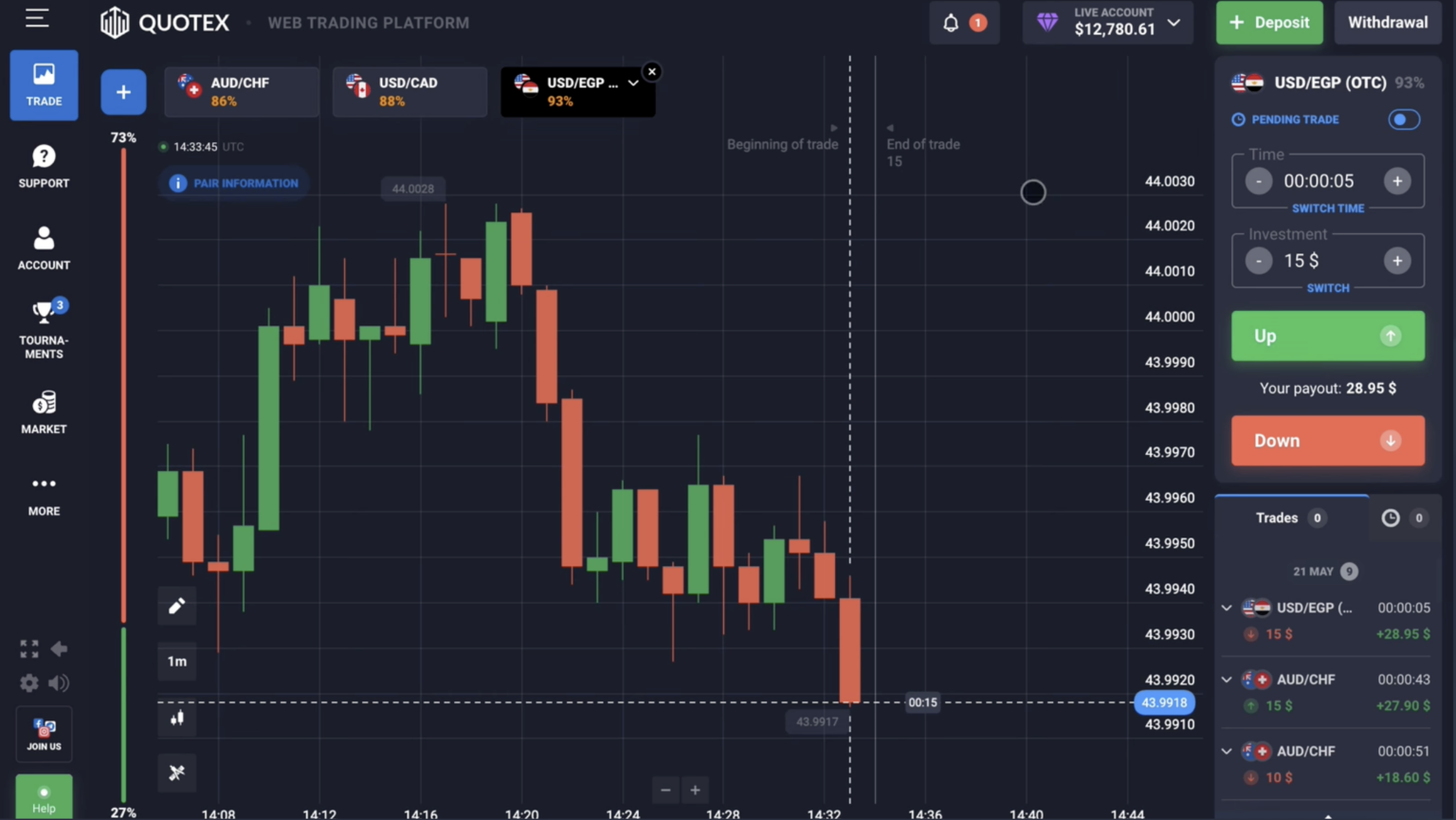
How to Use Indicators on Quotex
Technical indicators are mathematical calculations applied to price and volume data that help traders identify market conditions: trend direction, momentum, volatility, and overbought/oversold levels. On Quotex, you can add indicators to any chart by clicking the indicators icon at the top of the chart and selecting from the list. Each indicator can be customized (period, color, levels) and you can layer multiple indicators on the same chart. The most effective approach is to combine 2-3 complementary indicators — for example, RSI (momentum) + EMA (trend) + Bollinger Bands (volatility) — rather than overloading the chart with 10 indicators that often give conflicting signals.
- Step 1 — Click the 'Indicators' icon at top of any Quotex chart
- Step 2 — Search for the indicator by name or browse the list
- Step 3 — Click 'Add' to apply with default settings
- Step 4 — Click the gear icon next to the indicator name to customize period, color, levels
- Step 5 — Save your chart layout (Layouts → Save) for one-click reload
Indicator Deep-Dive Guides
Each indicator below has a dedicated guide with formula, settings, and worked examples.
Indicator Categories — Trend vs Momentum vs Volatility
Indicators fall into three primary categories based on what they measure. Understanding the category helps you choose complementary indicators that give different signals rather than redundant ones.
| Category | Indicators | What It Tells You | When to Use |
|---|---|---|---|
| Trend | EMA, SMA, MACD line | Direction of dominant price movement | Identifying trade direction |
| Momentum | RSI, Stochastic, MACD histogram | Speed and strength of price moves | Timing entries and reversals |
| Volatility | Bollinger Bands, ATR | Magnitude of recent price changes | Position sizing, expiry selection |
| Volume | Volume bars, OBV | Strength behind price moves | Confirming breakouts and reversals |
Best Indicator Combinations for Binary Options
On binary options' short timeframes (1m to 30m expiries), the most reliable indicator combinations balance trend identification with timing precision. Below are five tested combinations from our editorial backtest.
- Combination 1 — EMA(9) + EMA(21) + RSI(14): trend direction from EMA crossover, entry timing from RSI oversold/overbought reversal
- Combination 2 — Bollinger Bands(20,2) + RSI(14): trade band touches with RSI confirmation (RSI < 30 at lower band = buy; RSI > 70 at upper band = sell)
- Combination 3 — MACD + EMA(50): MACD signals in direction of EMA(50) slope — filters out counter-trend MACD signals
- Combination 4 — Stochastic + ATR: Stochastic crossovers in normal-volatility periods only (ATR within 0.8-1.2× its 20-period average)
- Combination 5 — Pure price action + ATR for position sizing: read candle patterns + use ATR to size position relative to typical noise
Common Indicator Mistakes
- Mistake 1 — Using too many indicators (more than 3-4 active) — leads to analysis paralysis and conflicting signals
- Mistake 2 — Treating indicator signals as predictions rather than probabilities — RSI > 70 doesn't mean immediate reversal
- Mistake 3 — Ignoring chart timeframe — indicator settings that work on 1h chart often fail on 1m chart
- Mistake 4 — Not understanding the formula — using indicators as black boxes leads to misinterpretation of signals
- Mistake 5 — Curve-fitting on past data — finding indicator settings that perfectly fit historical data but fail in real trading
- Mistake 6 — Skipping the underlying price action — indicators are derivatives of price, not substitutes for reading the price chart itself
Frequently Asked Questions
Which single indicator is best for binary options?
There is no single 'best' indicator — different indicators serve different purposes. If forced to pick one, RSI is the most versatile because it works in trending and ranging markets and provides multiple signal types (overbought/oversold, divergence, midline crosses). For trend-only markets, EMA crossover is simpler and more profitable. The best practice is combining 2-3 indicators from different categories.
How many indicators should I use at once?
Two or three from different categories. Adding more indicators rarely improves results and often makes decisions harder because you wait for too many simultaneous signals. A common professional setup is: one trend indicator (EMA), one momentum indicator (RSI), and one volatility filter (ATR or Bollinger Bands).
Do default indicator settings work, or should I customize?
Default settings (RSI 14, EMA 9/21, MACD 12/26/9, Bollinger 20/2) are starting points that work reasonably well. For shorter timeframes (1-minute charts), faster settings often work better — RSI 7 or 9 instead of 14, EMA 5/13 instead of 9/21. Test customizations on demo for at least 50 trades before applying to live trading.
Can indicators predict where the price will go?
No, indicators do not predict the future. They describe the current state of price (trending up, oversold, high volatility) based on historical data. Indicator signals are probabilities — when RSI shows oversold, prices have historically reversed more often than continued falling, but not always. Treat indicator signals as inputs to your decision, not predictions.
Should I use the same indicators on all timeframes?
You can, but settings should change. RSI 14 works on 1h chart but may be too slow on 1m chart. EMA 21 on 5m chart corresponds roughly to EMA 85 on 1m chart. Always consider what 'period 14' means in clock time on your current chart — 14 candles is 14 minutes on a 1m chart but 14 hours on a 1h chart.
Are indicator signals more reliable on some assets than others?
Yes. Trending markets (forex majors during London session, BTC during US session) give cleaner trend-following signals. Choppy markets (Asian session forex, low-volume periods) generate many false signals. Use ATR or Bollinger Band width to assess current market state before relying on indicator signals — high volatility = more reliable trend signals; low volatility = more reliable range signals.
Quotex
Divulgación: los enlaces de registro en esta página pueden generarnos una comisión sin coste adicional para usted. Esto no afecta la precisión editorial.