

Binary Options Basics — Beginner's Complete Guide
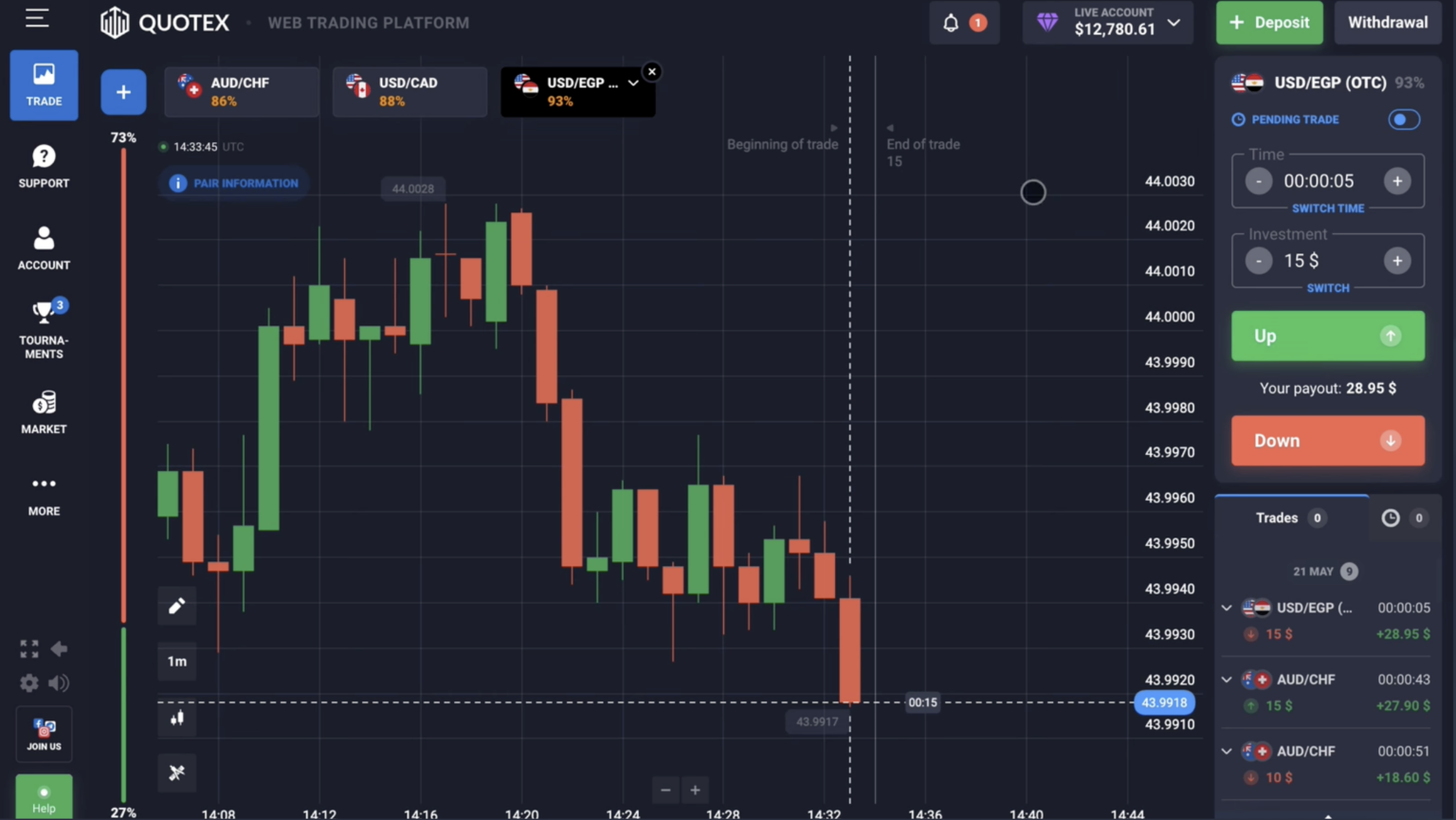
What Is a Binary Option?
A binary option is a contract that pays a fixed amount if the underlying asset's price meets a condition at expiry, or zero if it doesn't. The simplest form: you predict whether the asset's price will be higher (Call) or lower (Put) than its current price at the moment of expiry. If your prediction is correct, you receive a payout (typically 75-95% of your stake). If wrong, you lose the full stake. There is no partial outcome — binary, hence the name. The expiry is set when you place the trade (1 minute, 5 minutes, 1 hour, etc.). Once placed, you wait until expiry — you cannot 'stop out' a binary mid-trade like you can a spot position.
The Math of Asymmetric Payouts
Critical concept that beginners miss: binary options pay less than 100%, but lose 100% of stake. This asymmetry has massive implications for the win rate you need to break even. If payout is 85%, you need win rate > 54% just to break even (not to profit, just to break even). Math: at 50% win rate, you win $85 per win and lose $100 per loss → average outcome = $85 × 0.5 − $100 × 0.5 = −$7.50 per trade. You lose money even with 50% accuracy. To profit, you need consistent skill that produces 55%+ wins — much harder than it sounds. Most beginners underestimate this. The 'predict the next move' framing makes binary options feel like a coin flip, but the math is much worse than a coin flip due to the asymmetric payout structure.
| Payout % | Break-even Win Rate | Win Rate for 10% ROI |
|---|---|---|
| 75% | 57.1% | 62.9% |
| 80% | 55.6% | 61.1% |
| 85% | 54.1% | 59.5% |
| 90% | 52.6% | 57.9% |
| 95% | 51.3% | 56.4% |
Trading Modes on Quotex
Quotex offers three distinct binary modes. Choose based on your strategy timeframe.
- Binary Options (classic) — fixed payout, expiries from 30 seconds to 4 hours. Most popular mode.
- Digital Options — variable payout based on how far the strike is from current price. Higher payouts for less-likely outcomes.
- Quick Deal — fastest expiries (5s, 15s, 30s, 60s). For scalping. Lower payouts (70-80%). High emotional intensity.
Your First Demo Account
Before any real money is risked, open a Quotex demo account at /demo/. You get $10,000 in virtual funds, identical platform features, identical payouts. Spend at least 2 weeks practicing on demo before depositing real money. The demo isn't 'optional' — it's the only way to develop a strategy without the financial cost of learning through losses. Set position size to 1-2% of balance ($100-200 per trade on the $10,000 demo). Track every trade in a journal. Aim for 100+ trades before evaluating whether you have a strategy worth taking live.
Choosing Your First Asset and Strategy
Recommendation for absolute beginners: EUR/USD on 5-minute chart, during London-NY session overlap (13:00-17:00 UTC). Reasons: EUR/USD has the highest payouts on Quotex, the cleanest charts due to high liquidity, and the most documented strategies available. Use one of three beginner-friendly strategies from /strategies/: RSI oversold/overbought reversal, EMA 9/21 crossover, or Bollinger Band touch + RSI confirmation. Pick ONE and stick with it for 100 trades — switching strategies prevents you from getting statistically meaningful data on any single approach.
Common Beginner Mistakes
- Mistake 1 — Trading too soon: jumping to live trading after 5-10 demo trades. The data isn't statistically meaningful; you have no real edge yet.
- Mistake 2 — Position sizes too large: using 10-20% of balance per trade. This guarantees blow-up during inevitable losing streaks. Use 1-2%.
- Mistake 3 — Following social media signals: trading based on Telegram/Discord 'tips' from anonymous accounts. Almost always negative expected value.
- Mistake 4 — Martingale (doubling after losses): the math doesn't work at 85% payout. See /strategies/martingale/ for detailed proof.
- Mistake 5 — Trading during news: NFP, FOMC, CPI cause extreme volatility that disrupts any technical strategy. Avoid 10 min before to 30 min after.
- Mistake 6 — No journaling: trading without a record means you can't identify your own mistakes. Keep a notebook or spreadsheet.
- Mistake 7 — Revenge trading after losses: increasing position size to 'win back' losses. This is how 50% drawdowns become 90% drawdowns.
Realistic Expectations
Honest reality: about 70-80% of retail binary options traders lose money over their first 12 months. Of the 20-30% who break even or profit, most achieve 5-15% monthly returns — NOT the 100% monthly returns advertised in YouTube videos. The 1-2% of traders who consistently produce 30%+ monthly returns spend 4+ hours daily on the platform with sophisticated strategies refined over years. If your goal is to 'replace your salary' or 'get rich quickly,' binary options will disappoint you. If your goal is to develop a skill that can produce supplementary income over years of dedicated practice, the realistic path exists but requires the same time commitment as any other professional skill.
Binary Options Basics FAQ
How much money do I need to start?
Minimum deposit on Quotex is $10. We recommend $200-500 for your first live deposit — enough to take properly sized trades (1-2% per trade = $2-10 per trade) without immediate blow-up risk. Don't deposit money you can't afford to lose.
What's the difference between Call and Put?
Call (green up button) = bet that price will be HIGHER at expiry. Put (red down button) = bet that price will be LOWER at expiry. Same payout structure either way; just different direction. Most beginners default to Call bias because 'up = good' mentally — but down moves are equally tradeable.
Can I lose more than my stake?
No. Maximum loss on any single binary option is the stake amount. Unlike CFDs or leveraged futures, binary options have no negative balance risk. This is one of their main appeals — defined risk per trade.
Do I need to predict the exact price?
No. You only predict direction (higher or lower than entry). The size of the move doesn't matter — a 1-pip win pays the same as a 100-pip win. The only thing that matters is whether price is ABOVE your entry (for Call) or BELOW (for Put) at the moment of expiry.
What is expiry exactly?
Expiry is the specific moment your binary option settles. If you place a 5-minute binary at 14:00:00, expiry is 14:05:00. At that exact moment, the price is checked against your entry and the trade wins or loses. You cannot extend, exit, or modify the position before expiry.
Is binary options trading legal in my country?
Varies by jurisdiction. In some EU countries it's restricted to professional clients. In the US it's only legal on CFTC-regulated exchanges (NADEX). In most of the world it's legal but not specifically regulated. Check our country-specific guides (e.g., /quotex-india/, /quotex-pakistan/) for your jurisdiction. Always consult local laws before trading.
Quotex
Divulgação: os links de inscrição nesta página podem nos render uma comissão sem custo adicional para você.