

Quotex Telegram Signals — Honest Truth
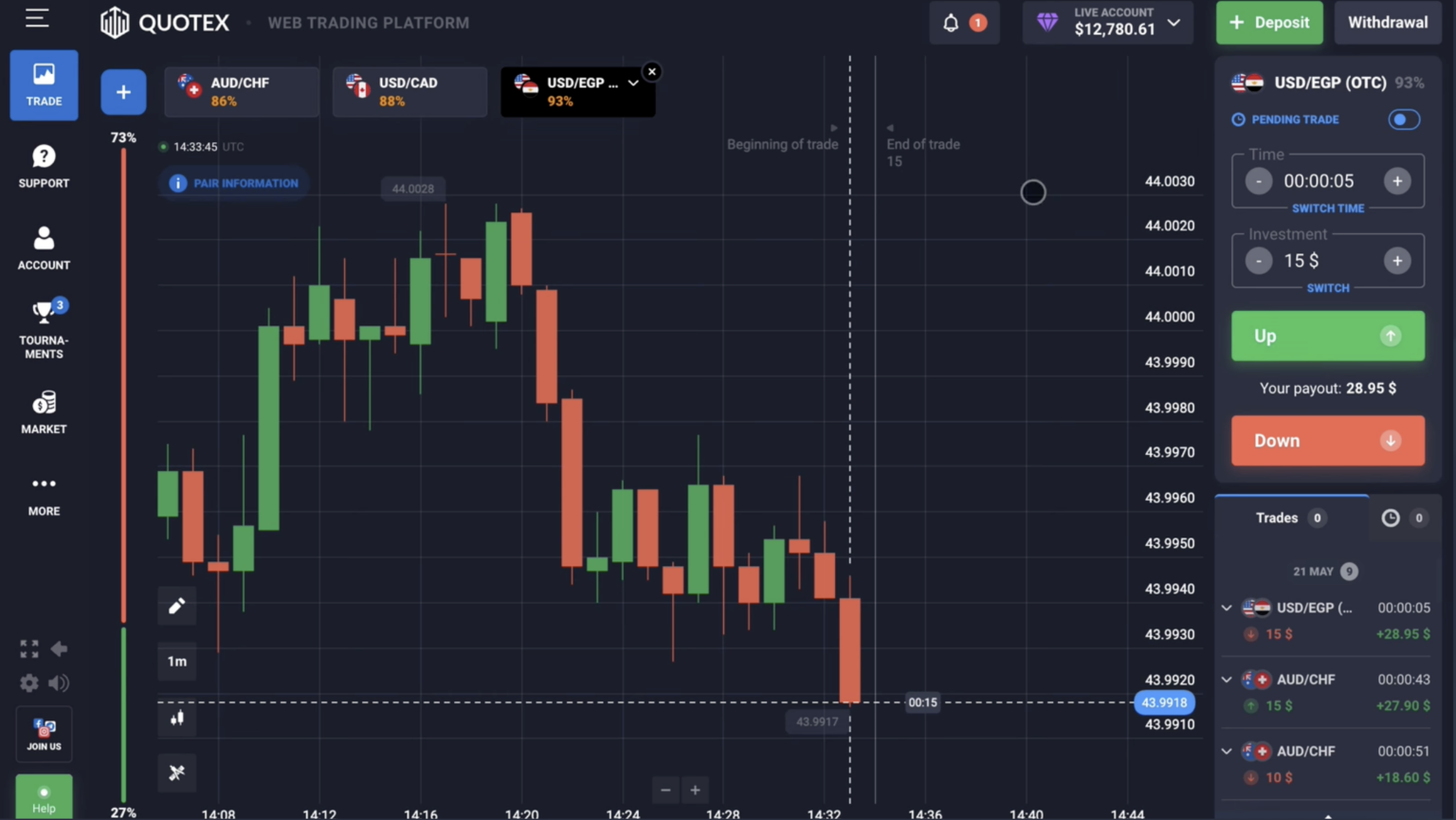
How Telegram Signal Channels Actually Operate
Telegram signal channels typically follow this pattern: (1) Free channel publishes 'signals' (CALL/PUT predictions with entry time and expiry) — initial signals often appear to win to attract subscribers; (2) Channel grows audience to 10,000-100,000+ subscribers; (3) Channel begins selling 'VIP' access for $50-500/month promising higher win rate; (4) Some VIP signals win, some lose — overall negative or break-even for users; (5) Channel collects subscription revenue indefinitely from rotating user base who try and quit. The economics work for the channel operator; the math doesn't work for users.
Why Signal Channels Show Winning Streaks
- Reason 1 — Selection bias: channels only publish their WINS, hiding losses
- Reason 2 — Multiple-channel hedging: if you post 100 signals across 10 channels (50% UP, 50% DOWN on same trades), some channel will show 'amazing win streak' by random chance
- Reason 3 — Demo screenshots: 'live withdrawal proof' often from demo accounts or other platforms
- Reason 4 — Pump-and-dump signals: signal everyone to CALL during low-volume periods; the volume itself pushes price briefly in CALL direction; signal appears profitable for first few who acted
- Reason 5 — Selective channel highlighting: channel showcases best month; ignores 11 worse months
The Economic Logic Test
Apply this test to any signal channel: IF the signals genuinely had 70%+ win rate at 85% payout, the channel operator would earn substantially more by trading the signals themselves than by selling them. At $100/month from 1,000 subscribers = $100,000/month gross revenue. At 70% win rate trading $1,000/trade with daily 10 trades = ~$15,000/day = $300,000/month with no subscriber-management overhead. Why doesn't every signal seller just trade their signals? Because the signals DON'T have 70% win rate. The signal business is profitable; the trading isn't.
Types of Signal Channels and Their Risk
| Type | Risk Level | Why |
|---|---|---|
| Free public Telegram with affiliate links | MEDIUM-HIGH | Channel earns from referral, may push poor brokers |
| Free signals with paid VIP upgrade | HIGH | VIP signals rarely better than free; pure revenue model |
| Paid private 'mentor' groups ($200+/month) | VERY HIGH | Aggressive upsells, often outright scams |
| 'Free' AI/bot generated signals | EXTREME | Often pump-and-dump or random signals with marketing |
| Major influencer paid signal services | HIGH | Marketing-driven; performance rarely matches claims |
| Genuine professional traders selling signals | VERY RARE | If exists, would be high-cost ($500+/month), small group |
Red Flags of Signal Channel Scams
- Red flag 1 — Promised win rates above 80% (mathematically unlikely for any strategy)
- Red flag 2 — Withdrawal proof videos as primary marketing (selection bias)
- Red flag 3 — 'Lifetime access' for one-time payment of $100-500 (cash grab pattern)
- Red flag 4 — Pressure to deposit through specific broker via affiliate link (channel earns commission, may push to inappropriate broker)
- Red flag 5 — 'No refund' policy combined with bold profit promises
- Red flag 6 — Anonymous channel operator (no real name, no verifiable trading credentials)
- Red flag 7 — Mass DMs/cold contact offering signals (legitimate services don't cold-contact)
- Red flag 8 — Account managers/agents asking for password access to 'trade for you'
Why Building Your Own Skill Outperforms Signals
- Skill compounds — your edge grows over years as you learn
- No subscription fees — every dollar saved is dollar earned
- You understand what you're doing — when signals fail, you adapt; when you fail, you debug
- Independence — not dependent on someone else's accuracy and continued operation
- Sustainable — strategies you understand and execute are sustainable; signals require constant subscription
- Trust — your own trading decisions deserve your trust; anonymous signal sellers don't
Genuine Alternatives to Paid Signals
- Alternative 1 — Our strategy guides at /strategies/ (free, comprehensive, no upsell)
- Alternative 2 — Our weekly market outlook at /market-outlook/ (free directional analysis)
- Alternative 3 — Demo practice (free, unlimited)
- Alternative 4 — Free educational content on Babypips School, Investopedia
- Alternative 5 — TradingView ideas (free public analyses by other traders)
- Alternative 6 — Quotex's own platform tools (built-in indicators, charts)
- Alternative 7 — Your own journal of demo and live trades (data-driven self-improvement)
If You Already Subscribed to a Signal Channel
- Action 1 — Cancel auto-renewal immediately
- Action 2 — Track signal performance honestly in spreadsheet for 4-8 weeks
- Action 3 — Calculate net P/L: signal wins × 85% minus signal losses
- Action 4 — If win rate <55% over 100+ signals, signals have negative expected value — unsubscribe
- Action 5 — Don't continue subscribing while losing 'in hopes things will improve'
- Action 6 — Refund disputes through your card company are sometimes successful if service didn't deliver promised results
Telegram Signals FAQ
Are ANY Telegram signal channels legitimate?
A small minority may be legitimate — but the cost-benefit of finding one rarely justifies the search. Even legitimate channels rarely outperform self-education. The 5-10% of channels that aren't outright scams typically have 55-60% win rate (marginal positive value), and you pay subscription fees that often eat the marginal edge. Your own self-developed strategy with no subscription cost typically matches or exceeds any signal service.
What about signal services from named professional traders?
More credibility but same economic logic applies. If they had genuine 70%+ edge, they'd be trading it institutionally. Some named professionals offer signals as side-business — these can be marginally useful but rarely 'easy money'. Investigate their verifiable trading record, not their marketing materials.
Why do free signals exist at all?
Three reasons: (1) Affiliate marketing — channel operators earn commission when you sign up to brokers through their links; (2) Audience building — free signals attract subscribers who later get pitched paid services; (3) Pump scheme — coordinating users to take same trade simultaneously creates brief price moves benefiting first-movers.
Can I make Quotex profits using signals safely?
Most signal users lose money. The few who profit are typically: (a) treating signals as one input among several technical analyses; (b) verifying signals against their own chart analysis before entering; (c) using strict position sizing regardless of signal 'confidence'. Treating signals as authoritative directives leads to losses.
Are 'AI' or 'bot' signal channels different?
Worse, usually. AI/bot framing is marketing — there's no breakthrough AI that generates profitable binary options signals (if there were, AI hedge funds would be using it). 'AI signals' channels are typically random signals dressed in tech-marketing language to seem sophisticated.
What's the realistic outcome of subscribing to signal channel?
Statistical expectation: pay $50-500/month subscription, achieve 50-55% win rate (below break-even at 85% payout), lose subscription cost plus trading losses. Net result: lose money to channel plus broker. Versus building skill via demo + free content: spend time learning, eventually achieve genuine 55-60% win rate, retain all profits. The math overwhelmingly favors self-education over paid signals.
Quotex
Раскрытие: ссылки регистрации на этой странице могут принести нам комиссию без дополнительной платы для вас. Это не влияет на точность нашего контента.