

Harami Pattern — Quotex Trading Guide
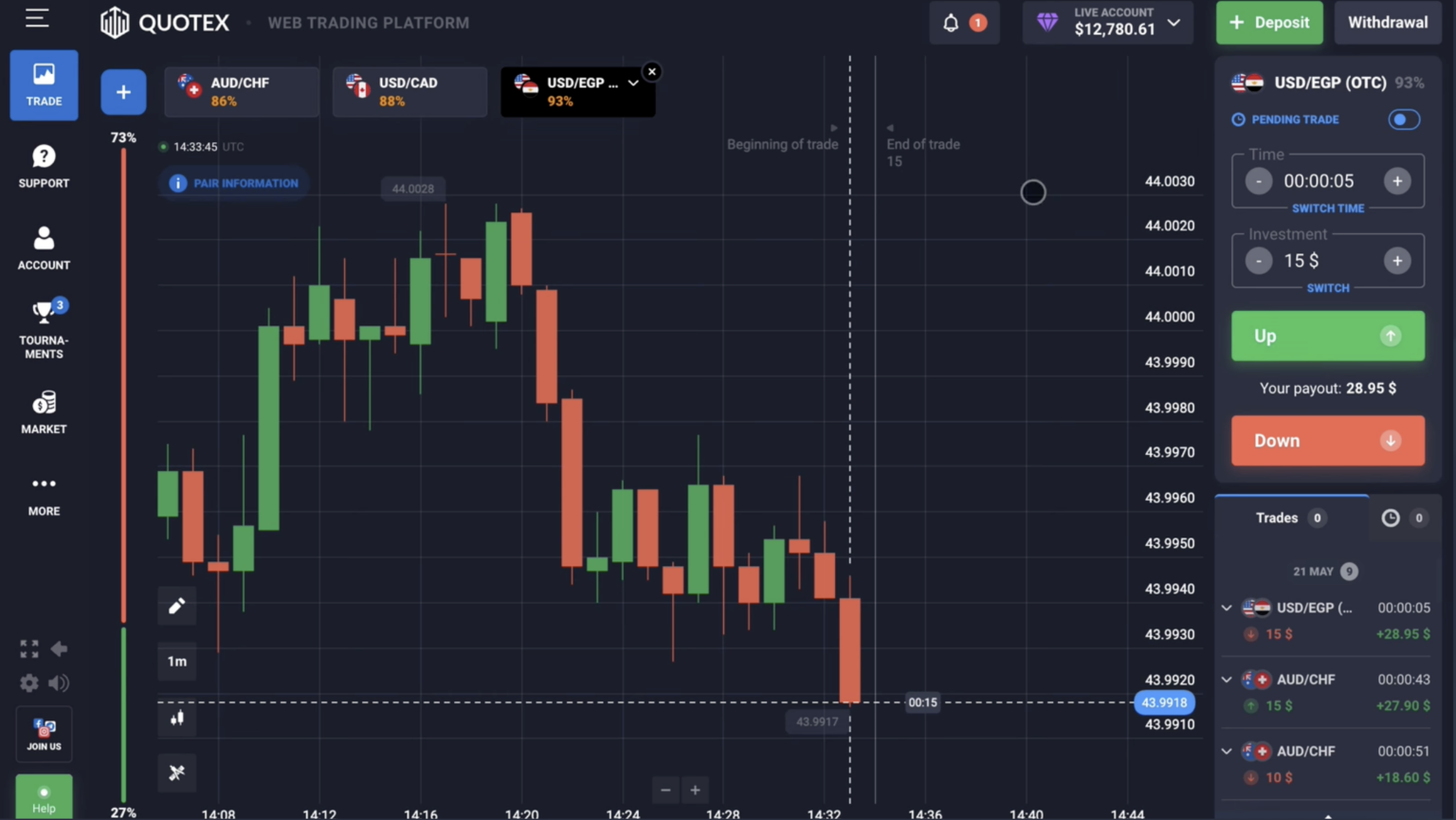
Harami Pattern Anatomy
Harami is the inverse of engulfing: in engulfing, the larger second candle covers the smaller first candle. In harami, the smaller second candle is contained inside the larger first candle. The Japanese name 'pregnant' captures this — the first candle is the 'mother', the second small candle is the 'child' contained inside.
| Type | Candle 1 | Candle 2 | Signal |
|---|---|---|---|
| Bullish harami | Large bearish (red) | Small bullish (green) — body inside candle 1 body | Potential downtrend reversal |
| Bearish harami | Large bullish (green) | Small bearish (red) — body inside candle 1 body | Potential uptrend reversal |
What Harami Signals
After a strong directional move (candle 1), the trend pauses and the next period shows much less momentum (candle 2 with smaller body). This indicates trend exhaustion — the dominant force is losing power. Harami doesn't strongly predict reversal; it warns of trend weakening. Confirmation is required before trading.
- Bullish harami after downtrend = bears losing power; bulls may reverse
- Bearish harami after uptrend = bulls losing power; bears may reverse
- Harami in middle of trend (no clear top/bottom) = less reliable
- Harami at major S/R level = most reliable variant
Harami vs Engulfing
| Aspect | Harami | Engulfing |
|---|---|---|
| Mechanism | Small 2nd candle inside large 1st | Large 2nd candle covers small 1st |
| Signal strength | Moderate (trend weakening) | Strong (decisive reversal) |
| Win rate alone | ~55% | ~58-60% |
| Win rate with S/R + confirmation | ~62% | ~63-65% |
| Best context | Subtle trend exhaustion warning | Clear momentum reversal |
Entry Rules
- Step 1 — Identify harami at significant S/R level after clear trend
- Step 2 — Wait for THIRD candle to confirm direction (after the inside small candle 2)
- Step 3 — Strong confirmation: third candle large and in reversal direction
- Step 4 — Enter on candle 4 (i.e., after confirming candle closes)
- Step 5 — Expiry: 1-2× chart timeframe
Harami FAQ
Is harami a weak engulfing?
Different signal type, not just weak engulfing. Engulfing signals decisive momentum reversal — buyers (or sellers) took control aggressively. Harami signals momentum exhaustion — buyers (or sellers) ran out of energy. Both can precede reversals but the mechanics differ.
Should the 2nd candle be opposite color?
Traditional definition: yes (red after green, or green after red). Some modern definitions accept any small inside candle. Strict traditional harami with opposite-color smaller candle is the most reliable variant.
What about 'harami cross'?
Harami cross is a variant where the second candle is a Doji (rather than just a small body). Stronger signal than standard harami because the Doji emphasizes maximum indecision after the strong first move. Win rate ~5% higher than standard harami.
Can harami fail in trending markets?
Yes — frequent failure mode. In strong trends, harami often appears mid-trend as just a brief pause; the trend then resumes. To filter: only trade harami at established S/R levels OR after multi-day extended moves where exhaustion is plausible.
Does harami work on cryptocurrency?
Yes — particularly on 1h-4h timeframes where crypto's longer trends provide cleaner exhaustion signals. 1m harami on crypto is too noisy.
How does harami compare to inside bar pattern?
Inside bar = candle whose entire range is within prior candle's range (including wicks). Harami = body of candle 2 within body of candle 1 (wicks may extend). Inside bar is broader; harami is body-focused. For binary options, harami's body-focused definition is more useful because it filters out wick-only false signals.
Quotex
Disclosure: Sign-up links on this page may earn us a commission at no extra cost to you. This does not affect the editorial accuracy of our content — payouts, methods, and platform features are reported as observed.