

Ichimoku Cloud on Quotex — Complete Guide
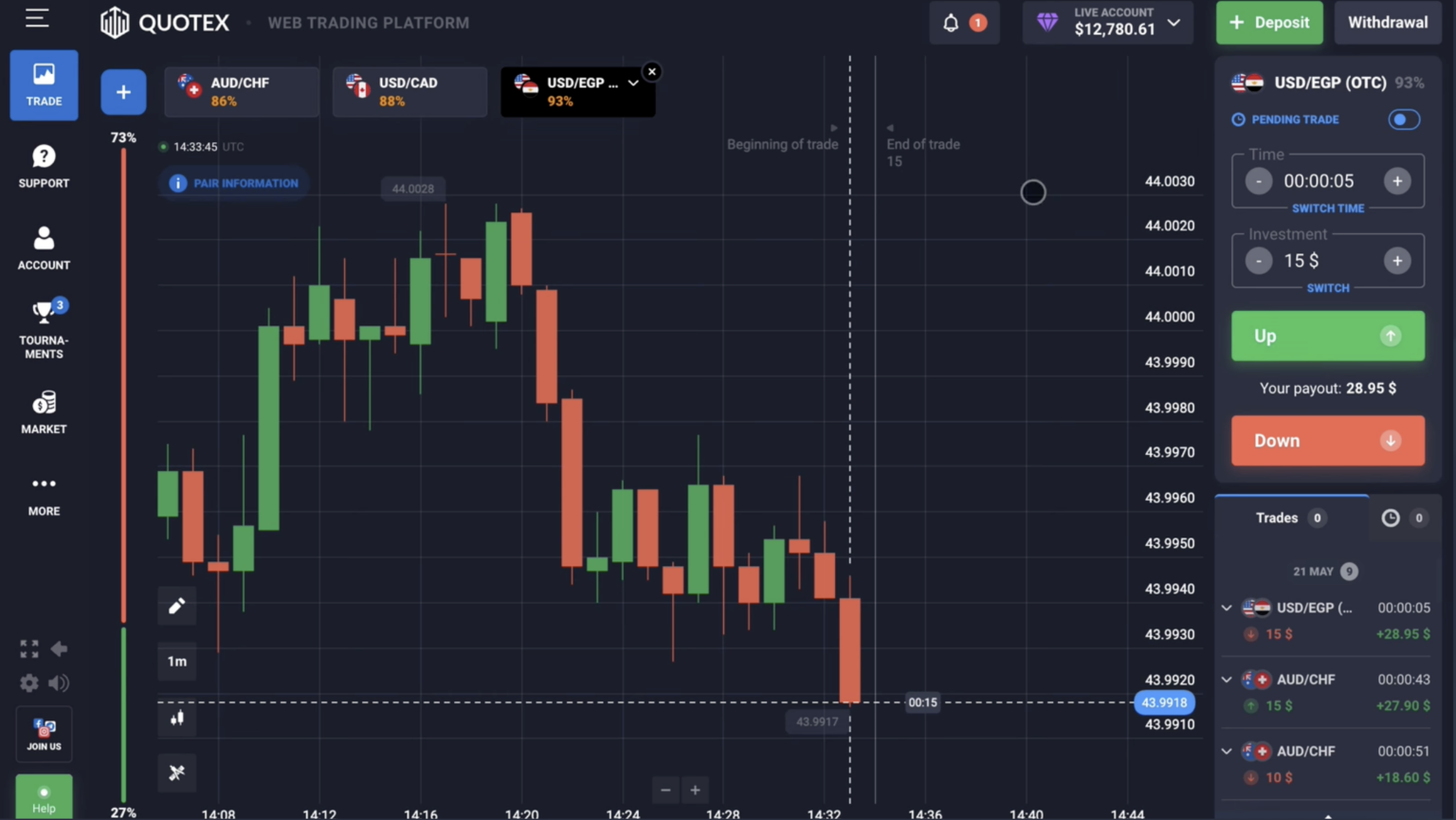
The 5 Components of Ichimoku
Ichimoku consists of five distinct lines/areas, each providing different market information.
| Component | Japanese Name | Calculation | Meaning |
|---|---|---|---|
| Conversion Line | Tenkan-sen | (9-period high + 9-period low) / 2 | Fast trend (~9 candles) |
| Base Line | Kijun-sen | (26-period high + 26-period low) / 2 | Medium trend (~26 candles) |
| Leading Span A | Senkou Span A | (Tenkan + Kijun) / 2, plotted 26 forward | Future cloud upper/lower |
| Leading Span B | Senkou Span B | (52-period high + 52-period low) / 2, plotted 26 forward | Future cloud upper/lower |
| Lagging Span | Chikou Span | Current close plotted 26 candles back | Confirms trend strength |
The Cloud (Kumo) — Most Important Element
The 'cloud' is the shaded area between Senkou Span A and Senkou Span B. It's the most distinctive feature of Ichimoku and provides three types of information simultaneously: (1) Direction — green cloud = bullish bias, red cloud = bearish bias; (2) Strength — thick cloud = strong trend, thin cloud = weak trend (potential reversal); (3) Support/Resistance — cloud edges act as dynamic support/resistance levels. When price is above the cloud, uptrend bias; when below, downtrend bias; when inside, no clear trend (range).
Default Settings
| Parameter | Default (Western) | Default (Japanese Original) |
|---|---|---|
| Tenkan-sen | 9 | 9 |
| Kijun-sen | 26 | 26 |
| Senkou Span B | 52 | 52 |
| Chikou Span offset | 26 | 26 |
Five Ichimoku Signal Types
- Signal 1 — Cloud breakout (price moves from inside cloud to clearly above/below) — strongest trend signal
- Signal 2 — Tenkan/Kijun cross (similar to MACD signal cross) — early trend signal
- Signal 3 — Price/Kijun cross (price crosses through baseline) — medium-term trend signal
- Signal 4 — Chikou span confirmation (lagging span above/below price 26 candles ago) — trend strength confirmation
- Signal 5 — Cloud color change (green to red or vice versa, forecasted 26 candles ahead) — early reversal warning
Best Strategies with Ichimoku
- Strategy 1 — Cloud breakout: enter CALL when price closes above cloud after below; enter PUT when price closes below cloud after above. Expiry: 1-2 hours on 15m chart.
- Strategy 2 — Tenkan/Kijun cross + cloud confirmation: bullish cross + price above cloud + chikou above past price = high-confidence CALL
- Strategy 3 — Kijun reversion: price extends far from Kijun, mean-reversion back to Kijun. Trade direction back toward Kijun line.
- Strategy 4 — Cloud thickness: trade trends only when cloud is thick (>1× ATR); avoid thin clouds (likely reversal zones)
When Ichimoku Fails
- Ranging markets — multiple components give conflicting signals; cloud is thin
- First 30-50 candles of a chart — cloud hasn't fully formed (needs 26 candles minimum)
- Major news events — fundamental shifts override technical Ichimoku setup
- 1-minute or shorter timeframes — too much noise for Ichimoku's smoothing parameters
- After significant gaps (weekend, news) — cloud projection becomes unreliable
Three Worked Examples
- Example 1 — EUR/USD 15m, May 7 2026 14:00 UTC: bullish cloud breakout above $1.0890; Tenkan crossed above Kijun; Chikou confirmed above past price. Entered CALL 1h expiry. Exit 1.0930 → WIN, +$21 on $25 stake.
- Example 2 — BTC/USD 1h, May 11 2026 17:00 UTC: price extended 2× ATR above Kijun at $62,500. Mean-reversion setup. Entered PUT 2h expiry. Exit $61,200 → WIN, +$21.
- Example 3 — Gold 15m, May 13 2026 14:30 UTC: tried cloud breakout PUT during US CPI release — too noisy. Cloud signal valid but timing destroyed by news volatility. Exit at LOSS, -$25. Lesson: avoid Ichimoku signals during news events.
Ichimoku FAQ
Is Ichimoku too complex for binary options?
Initially complex, but simplifies with practice. Once internalized, Ichimoku provides more information per chart than 3-4 other indicators combined. For binary options' short timeframes, focus on cloud breakouts and Tenkan/Kijun crosses — these are the highest-probability Ichimoku signals.
Should I use Western or Japanese-traditional Ichimoku settings?
Default 9/26/52/26 settings work for both. Japanese traditional uses the same numbers (these were Hosoda's original parameters based on Japanese 6-day trading week × time-frame multiples). No reason to deviate.
Can Ichimoku work on cryptocurrency?
Yes — particularly well. Crypto's strong trending nature suits Ichimoku's trend-following approach. BTC weekly Ichimoku has historically signaled major trend changes effectively. For binary options on crypto, use 15m-1h Ichimoku setups.
What's the strongest Ichimoku signal?
Cloud breakout confirmed by multiple components: price clearly above cloud + Tenkan/Kijun bullish cross + Chikou span clearly above past price + thick cloud color change to green. When all four align, win rate exceeds 70%. Such alignments occur 1-2 times per week on major pairs.
Does Ichimoku replace other indicators?
Can replace 3-4 separate indicators (moving averages, support/resistance, momentum). Some traders use Ichimoku exclusively. Others combine with RSI for momentum confirmation or ATR for volatility filter. Personal preference; both approaches valid.
Quotex
إفصاح: قد تكسبنا روابط التسجيل في هذه الصفحة عمولة دون أي تكلفة إضافية عليك.