

Doji Candlestick Patterns on Quotex
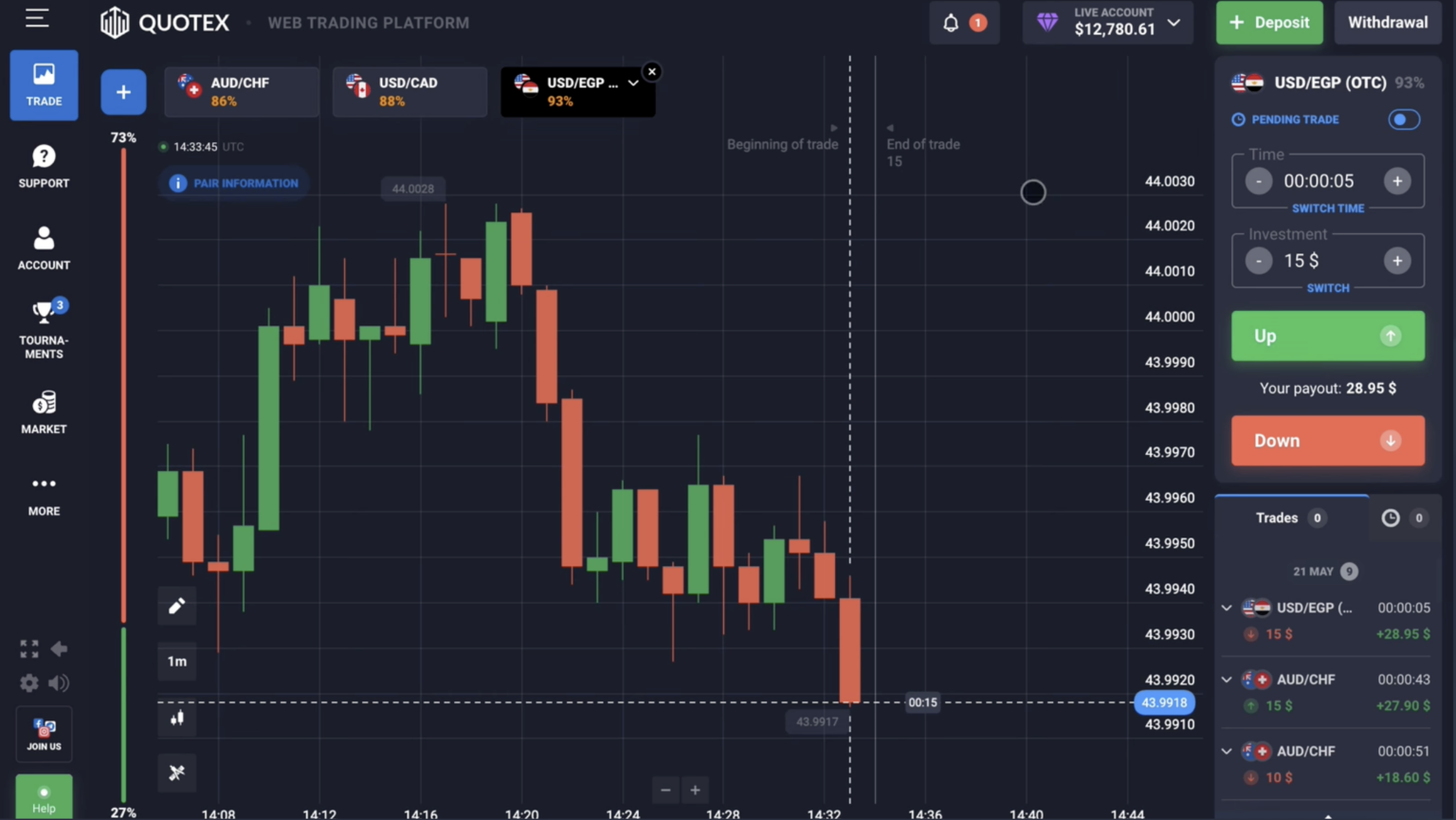
Four Doji Variants
| Variant | Description | Typical Meaning |
|---|---|---|
| Standard Doji | Small body, equal wicks on both sides | Pure indecision; trend pause |
| Long-Legged Doji | Small body, very long wicks on both sides | Extreme indecision; high volatility |
| Dragonfly Doji | Small body at top, long lower wick, no upper wick | Bullish reversal (similar to Hammer) |
| Gravestone Doji | Small body at bottom, long upper wick, no lower wick | Bearish reversal (similar to Shooting Star) |
What Doji Signals
Doji indicates the market opened and closed at essentially the same price after intra-period struggle. This means: (1) After a trend, Doji often signals trend exhaustion (potential reversal); (2) In a range, Doji is just normal indecision (no actionable signal); (3) After consolidation, Doji can precede breakout (energy compressed). Context matters more than pattern alone.
Trading Doji on Quotex
- Setup 1 — Doji at top of uptrend at resistance = potential bearish reversal (PUT signal)
- Setup 2 — Doji at bottom of downtrend at support = potential bullish reversal (CALL signal)
- Setup 3 — Dragonfly Doji at support = stronger bullish signal (CALL)
- Setup 4 — Gravestone Doji at resistance = stronger bearish signal (PUT)
- Setup 5 — Standard Doji in middle of range = NO TRADE; just market indecision
Confirmation Required
Doji alone is NOT a trading signal — it's only an indication that the prior trend may be losing power. Always wait for CONFIRMING candle:
- After Doji at uptrend top — wait for bearish candle close → THEN enter PUT
- After Doji at downtrend bottom — wait for bullish candle close → THEN enter CALL
- Strong confirmation: confirming candle is larger than Doji + closes well into Doji's range
- Weak confirmation: small confirming candle that barely registers
Doji Win Rate
| Setup | Win Rate |
|---|---|
| Doji alone (no level, no confirmation) | 50% (random) |
| Doji at S/R level (no confirmation) | 55% |
| Doji at S/R + confirming candle | 62% |
| Dragonfly/Gravestone at S/R + confirming candle + RSI extreme | 68% |
Doji FAQ
How small must the body be to count as Doji?
Convention: body less than 5% of total candle range. Some platforms automatically tag Doji candles. Larger bodies (5-25% of range) are 'small-body candles' but not true Doji.
Are Doji reliable on cryptocurrency?
Yes — particularly Dragonfly and Gravestone at psychological levels. BTC/ETH 1h Doji at $60k/$65k round numbers have been reliable reversal signals in our backtest. Standard Doji on crypto less reliable due to higher base volatility.
What's the difference between Doji and Spinning Top?
Doji has essentially equal open/close. Spinning Top has small body with longer wicks but body is more substantial than Doji. Both signal indecision but Doji is the stronger version (more equal price action between buyers and sellers).
Should I trade every Doji?
No — Doji in a range is just noise. Only trade Doji at meaningful levels (S/R, EMA) WITH confirmation. Random Doji elsewhere is just market chatter.
Can multiple Doji in a row mean anything?
Yes — consecutive Doji (3+ in a row) often precede major breakouts. The compressed indecision builds energy that eventually resolves directionally. Watch for breakout from the consolidation; trade in breakout direction with 30-60 min expiry.
Which Doji is strongest signal?
Dragonfly Doji at established support is the strongest single-candle bullish signal in our backtest. Gravestone Doji at established resistance is the strongest bearish. Both essentially function as 'extreme pin bars' with even smaller bodies than typical pin bars.
Quotex
إفصاح: قد تكسبنا روابط التسجيل في هذه الصفحة عمولة دون أي تكلفة إضافية عليك.