Quotex Demo Account
Practice trading on the Quotex demo account using virtual funds, real market charts, and core platform features.
The demo mode lets you test strategies and explore trading tools without financial risk, before switching to a real account.
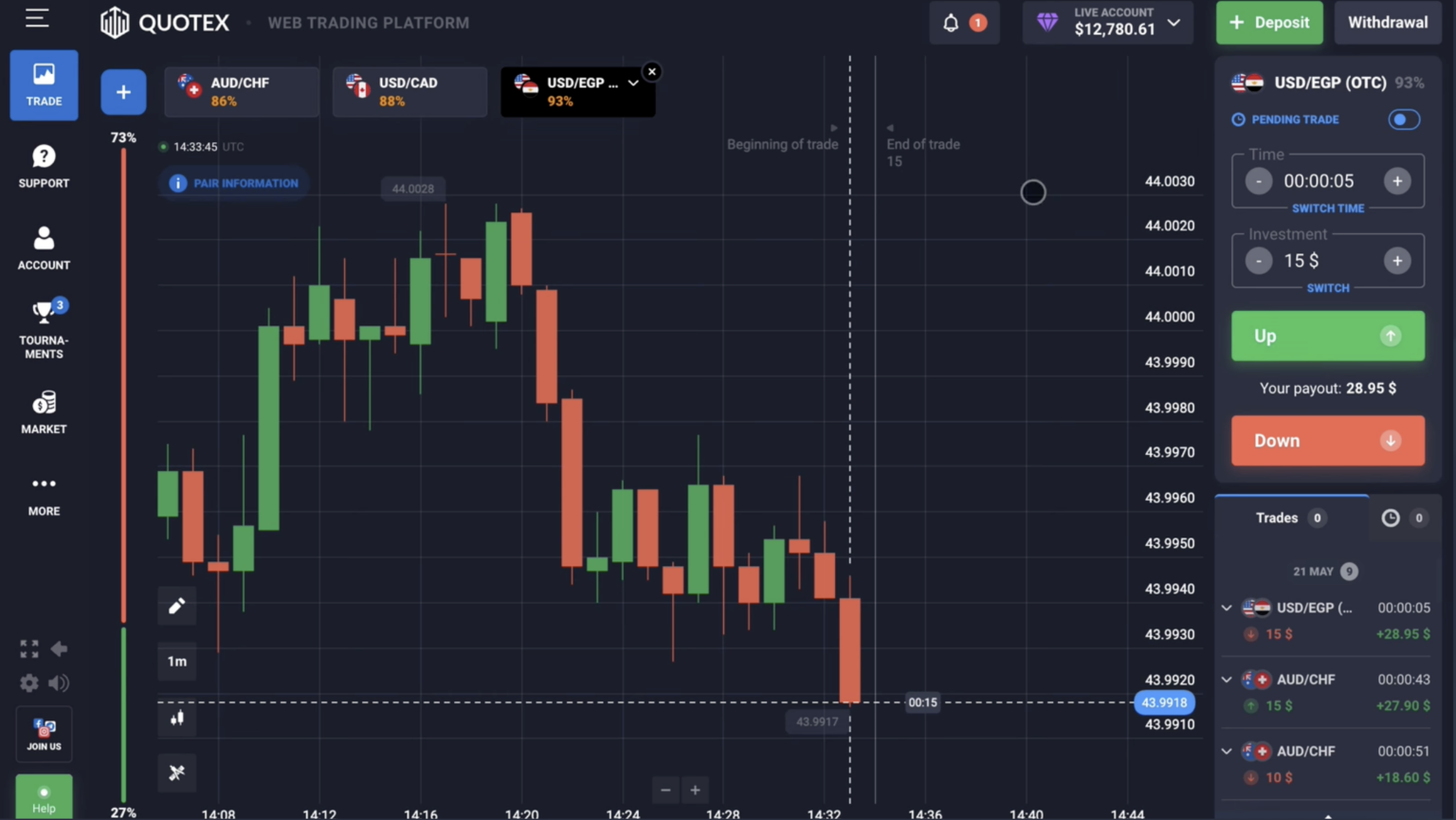
Quotex Demo:
Complete Guide to Practice Trading Without Risk
What is a Quotex Demo Account
A Quotex demo account is a practice platform with virtual $10,000 where you can learn binary options trading without risking real money. The prices are real, but the money isn’t.
Signing up takes one minute: go to the website, enter your email and password — done, your demo account is ready. No card details or identity verification required.
Why You Need a Demo Account
Beginners use demo for basic understanding: how to open trades, where the buttons are, how charts work. Without a demo account, you’d have to learn with real money, which gets expensive fast.
Experienced traders test new strategies on demo. Before risking money, they check if an idea works in history and real-time. If a strategy doesn’t work on demo — it definitely won’t work on a real account.
Quotex Demo vs Real Account Comparison
| Feature | Demo Account | Real Account |
|---|---|---|
| Initial Balance | $10,000 virtual | Minimum $10 deposit |
| Market Data | Real-time quotes | Real-time quotes |
| Available Assets | 400+ instruments | 400+ instruments |
| Risk Level | Zero financial risk | Real money at stake |
| Emotional Factor | Low pressure | High pressure decisions |
| Profit Withdrawal | Not available | Available anytime |
| Learning Value | High for practice | High for experience |
| Order Execution | Simulated | Real market fills |
What’s Available on the Demo Account
Demo has the same 400+ assets as the real account: currency pairs (EUR/USD, GBP/JPY), cryptocurrencies (Bitcoin, Ethereum), stocks (Apple, Tesla), commodities (gold, oil), indices (S&P 500, NASDAQ).
Indicators work fully: moving averages, RSI, MACD, Bollinger Bands, stochastic. You can draw trend lines, support and resistance levels, Fibonacci grids. Everything like in a professional terminal.
Timeframes from one minute to one month. Chart types: candles, lines, bars, Heikin-Ashi. Trade size from $1 to $1000, expiration time from one minute to several hours.
How to Use Quotex Demo Properly
Keep a trading journal. Write down every trade: why you opened it, what you analyzed, what emotions you felt, how it ended. Read it again in a month and you’ll see your mistakes.
Trade realistic amounts. If you’re planning to deposit $100 into a real account, then on demo make $2-5 bets, not $500. Otherwise on a real account you’ll get psychological shock from small amounts.
Test one strategy for at least a month. Don’t jump between methods every week. Give the strategy time to show results in different market conditions.
Take virtual money seriously. Blew your demo account? Don’t just reset the balance with a button — figure out what went wrong. There’s no “reload balance” button on a real account.
Common Mistakes on Demo
Many people open 50 trades a day because “it’s not real money anyway.” On a real account you can’t do this — emotions and commissions will eat your deposit.
The opposite extreme is trading on demo for a year, afraid to switch to a real account. Demo won’t give you experience managing fear and greed. These emotions only appear with real money.
Ignoring risk management. On demo it’s easy to bet 30% of your balance per trade, getting quick results. On a real account this approach will definitely blow your account in a few days.
When to Switch to a Real Account
Switch when you’ve been profitable for three months straight on demo. Not just “made $500 today,” but consistently every month. Keep statistics: percentage of profitable trades, average profit/loss, maximum drawdown.
You should have a clear trading strategy with entry and exit rules. “Trading by feel” isn’t a strategy. “I open a trade when RSI is below 30 and price touches the lower Bollinger Band” is better.
Learn to stop after a losing streak. If on demo after three losses in a row you keep trading “to win it back” — on a real account this will end badly.
Differences Between Demo and Real Account
Psychology. On demo you calmly watch a trade go $200 into the red. On a real account, when it’s your money, panic starts. Your hands shake, you want to close the position early.
Order execution. On demo, trades open at the price you see. On a real account, especially during volatile moments, there can be slippage of several points.
You can’t withdraw profit. It’s obvious, but many forget: demo profit only exists on the screen. On a real account, every dollar earned can be withdrawn to your card.
Switching to Real Trading
Start with a minimum deposit. If the minimum is $10 — deposit exactly $10, not $1000. The first months on a real account are a continuation of learning, just with real emotions now.
Trade the same amounts on real as on demo. If you made $2 bets on demo, don’t immediately increase them to $20 on real.
Keep using demo in parallel. Test new strategies there first. Real account is only for proven methods.
The first month the main goal isn’t to earn, but not to blow the deposit. Even breaking even counts as success. You’re getting used to the psychological pressure of real money.
Quotex Mobile App
The app works on iOS and Android. Full functionality: same charts, indicators, assets. Balance syncs between phone and computer.
Convenient for those who can’t sit at a computer all day. Saw a good moment — opened the phone, made a trade, closed the app.
Downside of mobile version — less space for analysis. On a small screen it’s hard to look at multiple timeframes and indicators at once. For serious analysis, a computer is better.
Realistic Expectations
A demo account won’t make you a professional. It’s a tool for basic learning and testing ideas. Real experience only comes with real money.
If you’re consistently profitable on demo — that’s a good sign, but not a guarantee of success on real. Trading psychology changes dramatically when real money is at stake.
Use demo for its purpose: learn, test, make mistakes. But understand that sooner or later you’ll need to switch to real to get actual trading experience.
Most traders lose money on binary options. Even demo success doesn’t guarantee profit on a real account. Only trade with money you can afford to lose.
Build your trading confidence with smart, risk-free decisions
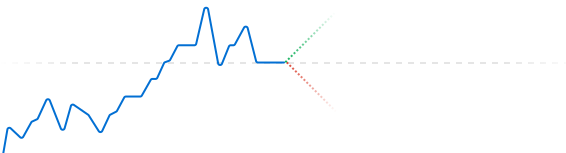
1. Choose an asset
2. Watch the chart
3. Execute a trade
4. View the resultп
Frequently asked questions about
Quotex Demo Account
Do I need to deposit money to use the demo account?
No. The demo account is completely free and doesn’t require any deposit. You get $10,000 in virtual funds immediately after registration. No credit card, no verification, no hidden fees.
How long can I use the demo account?
There’s no time limit. Your demo account stays active forever. You can practice for a week, a month, or a year — Quotex doesn’t restrict demo usage. Some traders keep their demo account even after switching to real trading to test new strategies.
Can I reset my demo balance if I lose all the money?
Yes, most platforms let you reset the balance back to $10,000 with one click in the account settings. However, before hitting that reset button, take time to understand what went wrong. Just reloading money without learning from mistakes defeats the purpose of demo trading.
Are the prices on demo the same as on a real account?
Yes, demo accounts use real market data. The quotes, spreads, and price movements are identical to what you’d see on a real account. The only difference is that you’re trading with virtual money, so there’s no emotional pressure.
If I make profit on demo, can I withdraw it?
No. Demo profits are virtual and cannot be withdrawn. The demo account exists purely for educational purposes. To earn real money that you can withdraw, you need to switch to a real trading account with an actual deposit.
Will my demo trading results guarantee success on a real account?
Not really. While good demo results are encouraging, they don’t guarantee real account success. The biggest difference is psychology — trading with virtual money feels completely different from risking your own cash. Fear, greed, and stress only appear when real money is on the line. Think of demo as learning to drive in an empty parking lot — helpful, but not the same as real traffic.