

Your First Week on Quotex — 7-Day Roadmap
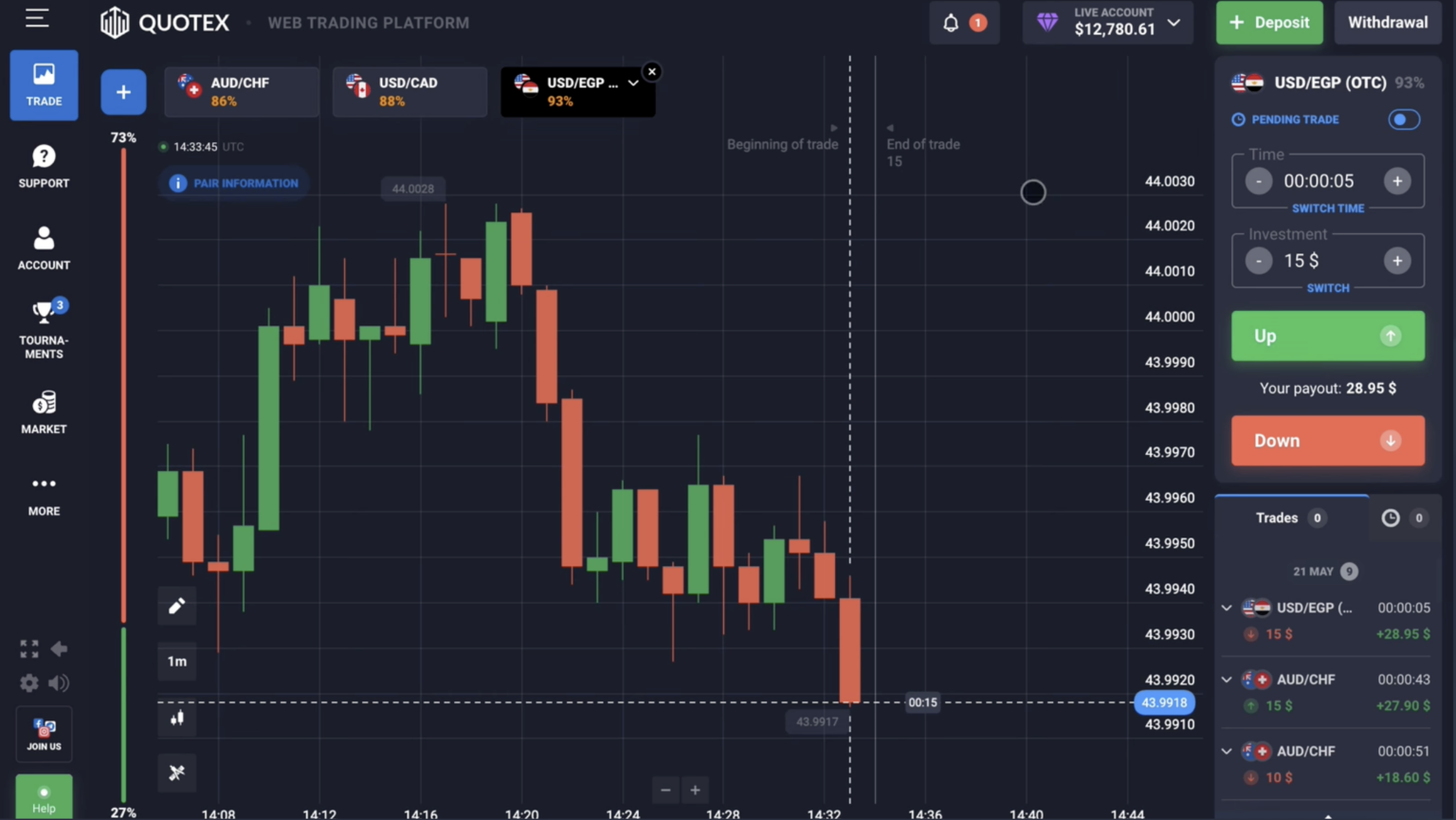
Day 1 — Setup and Platform Familiarization
- Morning (1 hour) — Register Quotex account; enable 2FA; save recovery codes on paper
- Read — /how-to-start/ (this guide), /risk-disclosure/, /editorial-policy/
- Afternoon (1 hour) — Explore platform interface on demo: chart, indicators, asset selector, trade window
- Evening — Place 10 random small demo trades just to understand the click-through experience
- Goal — Comfortable with platform mechanics by end of day
Day 2 — Understanding the Math
- Read — /education/binary-options-basics/ (covers payout asymmetry)
- Read — /tools/payout-calculator/ (calculate break-even win rates)
- Practice — Use payout calculator to model different scenarios; understand why 55%+ win rate is the threshold
- Demo — Place 15-20 demo trades with deliberate focus on noting which patterns lead to wins vs losses
- Goal — Internalize the math: this is skill-based probability, not coin flipping
Day 3 — Risk Management Fundamentals
- Read — /education/risk-management/ (position sizing, drawdown math)
- Practice — Use /tools/position-size/ to calculate appropriate stakes
- Demo — Place 20 trades using strict 1% position sizing throughout. Note how it feels (boring vs comfortable)
- Journal — Start a simple spreadsheet trade journal (see /education/journaling/ for template)
- Goal — Discipline yourself to 1% sizing before scaling up
Day 4 — Choose Your First Strategy
- Read — Browse /strategies/ hub; pick ONE strategy to focus on first
- Recommended for beginners: /strategies/rsi/ OR /strategies/ema-crossover/
- Study — Read your chosen strategy guide in detail; note entry rules, expiry selection, when to avoid
- Demo — Place 25 trades using your chosen strategy strictly during London-NY overlap (13:00-17:00 UTC)
- Journal — Record each trade in detail; note adherence to strategy
- Goal — Internalize one strategy completely
Day 5 — Understanding Indicators
- Read — Browse /indicators/ hub; deep dive on the indicator your chosen strategy uses
- Practice — Customize chart layout with your strategy's indicators; save layout for reuse
- Demo — 25 more trades with strategy + indicators; compare win rate to Day 4
- Goal — Confidence in setting up and reading your indicators
Day 6 — Trading Psychology Introduction
- Read — /education/trading-psychology/ (covers FOMO, revenge trading, discipline)
- Read — /education/dealing-with-losses/ (math of losing streaks)
- Demo — Deliberately place 20 trades during a stressful period (after work, with distractions) — note how performance differs from focused trading
- Goal — Awareness that mental state affects trading quality
Day 7 — Week 1 Review and Decision
- Calculate — Total demo trades, wins, losses, win rate %, net P/L
- Compare — Is win rate above 55%? (break-even threshold)
- Review journal — What patterns emerged in winning vs losing trades?
- Decision — If win rate > 55%: continue another week of demo at higher trade volume. If win rate < 55%: continue Week 1 routine for another week
- DO NOT — Deposit real money after just one week; that's too soon. Minimum recommendation: 4 weeks of consistent demo with 55%+ win rate before any real-money deposit
What NOT to Do in Week 1
- DON'T — Deposit real money (premature)
- DON'T — Try multiple strategies (overwhelms learning)
- DON'T — Trade more than 30 trades per day (overtrade = bad habit)
- DON'T — Follow Telegram signals (almost universally scams)
- DON'T — Increase position size beyond 1% (let strategy do the work)
- DON'T — Trade during news events (too volatile for learning)
- DON'T — Take losing trades personally (variance is expected)
Week 1 FAQ
What if my Week 1 win rate is below 55%?
Normal for beginners. Continue Week 1 routine (single strategy, demo only) for another 1-2 weeks. The first 50-100 trades are partly learning the strategy mechanics, not testing strategy efficacy. Statistical signal emerges after 100+ trades. Don't change strategy after one bad week.
Can I trade more than the recommended demo trades per day?
Diminishing returns above 30 trades/day. The marginal trade after 30 typically adds noise to your data without adding learning. Quality over quantity. 20-30 deliberately-executed trades teaches more than 100 sloppy trades.
Should I trade weekends in Week 1?
Yes if comfortable; no if not. Weekend OTC trading is part of Quotex's reality. If you'll eventually trade weekends, include weekend practice. If you only plan weekday trading, skip weekends and focus on weekday session timing.
Is one week really enough to start live trading?
Not for most beginners. Recommended minimum is 4 weeks of consistent demo with 55%+ win rate. Some experienced traders from related fields (forex, poker) can compress this — most cannot. Patience here saves money later.
What if I'm impatient and want to deposit money on Day 3?
Strong recommendation: don't. The asymmetric payout math means early-trader losses can be 5-10% of deposit per day during learning. Spending $100-300 in 2 weeks while learning on demo is much cheaper than depositing $500 and losing $400 in 5 days due to undeveloped skill. The math favors patience.
Can I skip the journal in Week 1?
Don't. Without a journal, you're operating on impression rather than data. By Day 7 you'll have no clear picture of what's actually happening in your trading. Even simple 5-column journal (asset, time, direction, outcome, notes) gives meaningful weekly insight. Invest the 30 seconds per trade — pays off for years.
Quotex
Disclosure: Sign-up links on this page may earn us a commission at no extra cost to you. This does not affect the editorial accuracy of our content — payouts, methods, and platform features are reported as observed.