

Binary Options Position Size Calculator
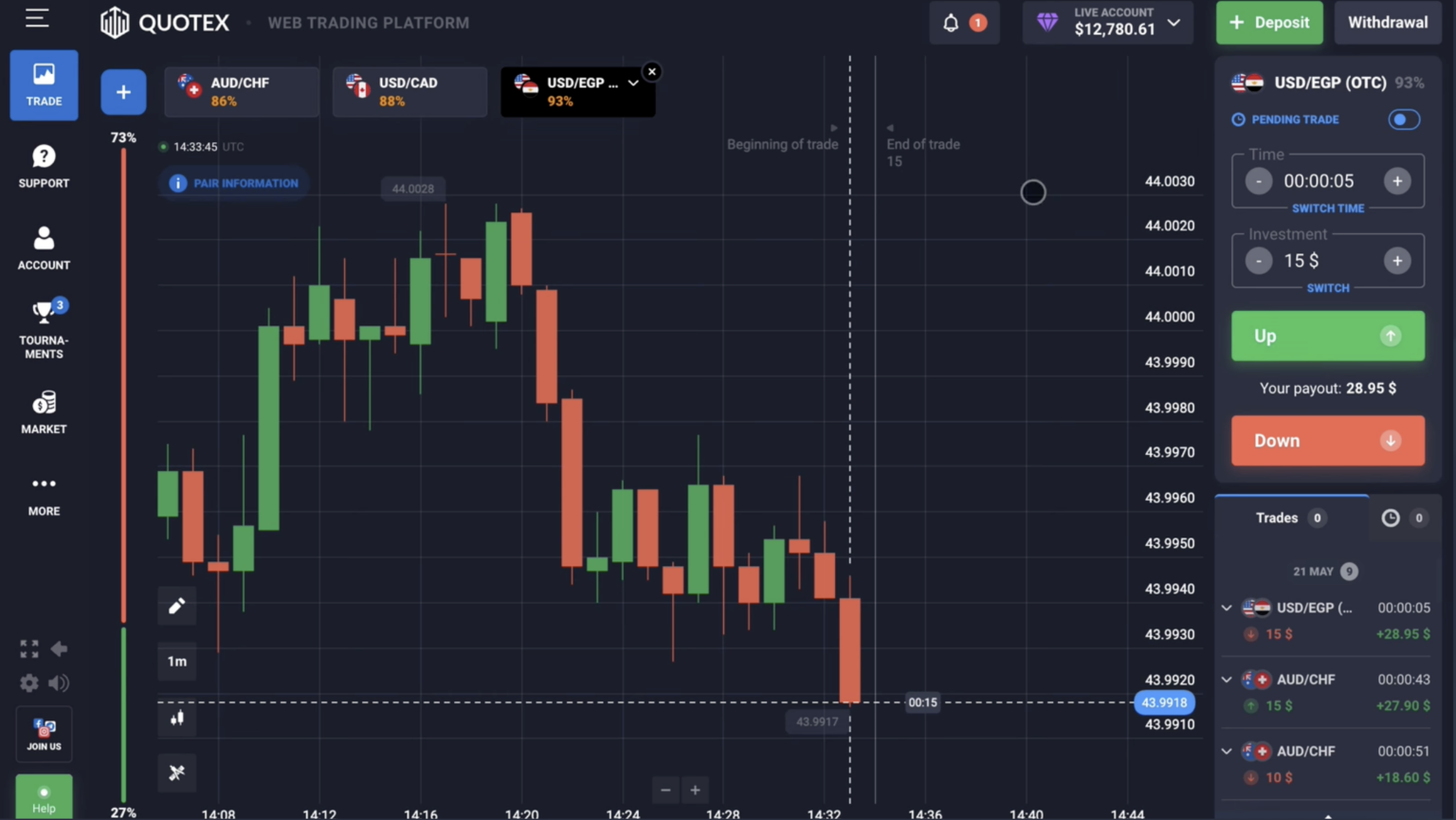
Why Position Size Matters More Than Strategy
A trader with a 60% win-rate strategy and proper position sizing makes consistent money. A trader with the same strategy but 10% position sizes per trade blows up the account within 100 trades from variance alone. Skill in trading is necessary but not sufficient — without proper position sizing, even great strategies fail. The math: at 60% win rate with 2% position sizing, your maximum expected drawdown is about 15-20%. At the same win rate with 10% position sizing, your maximum expected drawdown is 60-80%, often crossing into 'account-killing' territory. Position sizing is the difference between a hobby and a sustainable activity.
How to Use the Calculator
- Step 1 — Enter your current Quotex account balance in USD
- Step 2 — Enter your chosen risk percentage per trade (recommended: 1-2% for beginners, max 3% for experienced)
- Step 3 — Read the resulting stake amount in USD
- Step 4 — Use this stake amount for ALL trades — never deviate above this number even for 'high-confidence' setups
- Step 5 — Recalculate every time your balance changes by 10%+ (after deposits, withdrawals, or accumulated wins/losses)
Pre-Calculated Position Sizes
Below is a quick reference for common account sizes and risk percentages.
| Account Balance | 1% per trade | 2% per trade | 3% per trade | 5% per trade (NOT recommended) |
|---|---|---|---|---|
| $100 | $1 | $2 | $3 | $5 |
| $500 | $5 | $10 | $15 | $25 |
| $1,000 | $10 | $20 | $30 | $50 |
| $2,500 | $25 | $50 | $75 | $125 |
| $5,000 | $50 | $100 | $150 | $250 |
| $10,000 | $100 | $200 | $300 | $500 |
| $25,000 | $250 | $500 | $750 | $1,250 |
Why Not Higher Percentages?
Higher position sizes feel small in dollar terms ('it's only $50 on a $1,000 account!') but the percentage compounds painfully in losing streaks. Math: at 5% per trade and a 55% win rate strategy, the probability of a 6-loss streak is about 0.85% per trade — meaning over 500 trades, you'll experience roughly 4 such streaks. Each takes you down 30% (1 - 0.95^6 = 26.5% drawdown). Four such streaks over a year = compounding to 50%+ drawdown territory. At 2% per trade, the same 6-loss streak only takes you down 11.8% — recoverable. Position sizing isn't about being conservative; it's about staying in business long enough for your edge to play out.
Dynamic Adjustments
Static position sizing (always 2% of starting balance) is acceptable but not optimal. Better: recalculate based on current balance every 10% balance change. If you grow $1,000 → $1,200, recalculate to $24 per trade (2% of $1,200) — you're risking 2% of CURRENT balance, not original. This means: position sizes grow as you profit (compounding gains), shrink as you lose (preserving capital during drawdowns). This 'fixed fractional' approach is the standard professional method.
- After 10% gain — recalculate position size to 2% of new balance (slightly larger)
- After 10% loss — recalculate position size to 2% of new balance (slightly smaller)
- After 25% drawdown — drop to 1% per trade until you've recovered half the drawdown
- After 50% drawdown — STOP trading, review what went wrong, consider whether your strategy is broken
Position Sizing FAQ
What if my account balance is $50?
At $50 balance, even 2% is $1 — and Quotex minimum stake is typically $1, so 2% rule works exactly. With balances under $100, you're effectively trading at the Quotex minimum on every trade. This is fine for learning but creates very small dollar profits. Consider either growing the account slowly or depositing more — but never deposit more than you can afford to lose.
Should I increase position size after a winning streak?
No, beyond the normal recalculation as balance grows. Doubling down after wins ('I'm hot today') is the inverse of martingale and equally problematic. Your win rate is your win rate — recent results are statistical noise within the strategy's underlying probability. Stick to the percentage rule. Compounding will naturally grow position sizes over time as balance grows.
What about variable position sizing based on confidence?
Some traders advocate 'higher conviction = larger position.' We don't recommend this for beginners. Your sense of 'conviction' is largely emotional, not predictive. Backtest data rarely shows that 'high-conviction trades' have higher win rates than normal trades. Standardize position size and let strategy do the work.
Can I use this calculator for spot forex or CFDs?
Not directly. Spot/CFD position sizing involves leverage, stop-loss distance, and pip value calculations that don't apply to binary options. Use a forex-specific position size calculator for those products. Binary options sizing is simpler because the maximum loss per trade is always the stake amount.
What about psychological position sizing (smaller when feeling off)?
Valid practice. If you're sleep-deprived, emotionally upset, or in an unfamiliar environment, reduce position size by half (1% instead of 2%). This is risk management for human variables, not market variables. Even better: skip the trading session entirely until you're in a normal state. Many professional traders take 'no-trade days' when they're not at their best.
Quotex
Disclosure: Sign-up links on this page may earn us a commission at no extra cost to you. This does not affect the editorial accuracy of our content — payouts, methods, and platform features are reported as observed.