

Head & Shoulders Pattern on Quotex
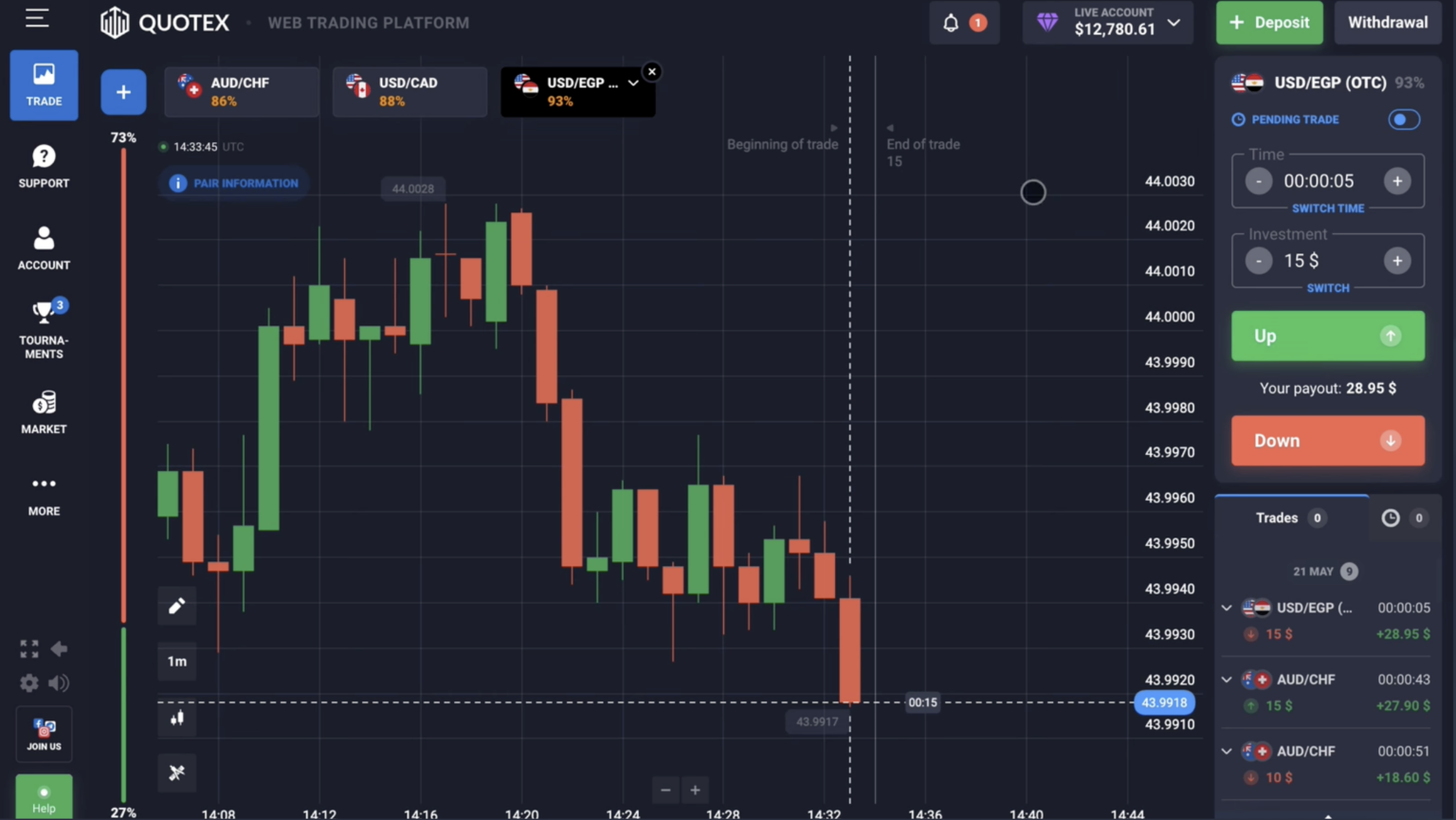
Pattern Anatomy
Classic Head and Shoulders (bearish):
- Left Shoulder — first peak after uptrend; price rises then pulls back
- Head — higher peak than left shoulder; price rises further then pulls back to similar level
- Right Shoulder — peak lower than head, often similar height to left shoulder
- Neckline — horizontal line connecting the lows between the shoulders
- Trigger — price closes below the neckline; signals trend reversal completion
Inverse Head and Shoulders (Bullish)
Inverse pattern at downtrend bottom — same anatomy but flipped:
- Left Shoulder — first low after downtrend; price falls then bounces
- Head — lower low than left shoulder; deepest point
- Right Shoulder — higher low than head, often similar depth to left shoulder
- Neckline — horizontal line connecting the highs between the shoulders
- Trigger — price closes above the neckline; bullish reversal signal
Identification Rules
- Rule 1 — Three distinct peaks (or three lows for inverse) visible on chart
- Rule 2 — Head must be clearly higher (or lower) than shoulders (≥1× ATR difference)
- Rule 3 — Left and right shoulders approximately equal height (within 20%)
- Rule 4 — Neckline should be relatively horizontal (downward slope acceptable for stronger bearish; upward slope acceptable for stronger bullish)
- Rule 5 — Pattern duration: minimum 30 candles (smaller patterns are unreliable)
Entry Rules
- Step 1 — Wait for clear right shoulder formation (don't anticipate before pattern completes)
- Step 2 — Watch for price approach to neckline
- Step 3 — Wait for CANDLE CLOSE below neckline (for classic) or above (for inverse)
- Step 4 — Enter on next candle in pattern direction (PUT for classic, CALL for inverse)
- Step 5 — Expiry: target = neckline distance from head (approximately equal move down/up after breakout)
Head and Shoulders Reliability
| Setup | Win Rate | Notes |
|---|---|---|
| H&S alone, weak pattern | 55% | Many false signals |
| H&S at confirmed S/R level | 65% | Confluence improves significantly |
| H&S with volume confirmation (if available) | 68% | Volume drops at right shoulder = bearish confirmation |
| H&S + RSI bearish divergence + S/R | 72% | Highest-confidence setup |
Common H&S Mistakes
- Mistake 1 — Pattern recognition bias — seeing H&S in random noise (false positives common)
- Mistake 2 — Entering before neckline break (premature)
- Mistake 3 — Trading the 'right shoulder' before pattern completes (just guessing)
- Mistake 4 — Ignoring trend context — H&S in middle of bigger trend often fails
- Mistake 5 — Trading minor sub-pattern H&S on 1m charts (too small to be meaningful)
Head & Shoulders FAQ
How long should Head and Shoulders take to form?
Minimum 30 candles, ideally 50-100+. The longer the pattern formation, the more reliable the eventual breakout. Daily-chart H&S patterns (forming over weeks-months) are extremely reliable when they break. Hourly H&S forming over 1-2 days is still useful for binary options.
What if the right shoulder is much smaller than left?
Asymmetric shoulders weaken the pattern but don't invalidate. Small right shoulder = weak retest = often signals strong reversal coming. Large right shoulder (significantly bigger than left) is suspicious — pattern may not be true H&S.
Can H&S patterns fail?
Yes — 30-40% of identifiable H&S patterns fail to produce expected reversal. Failures usually mean trend continues or pattern was misidentified. Use confirmation rules to filter most false patterns.
Does H&S work on cryptocurrency?
Yes, particularly on 4h-daily timeframes. BTC weekly H&S patterns have been textbook reliable. Crypto's tendency for clear directional moves produces clean pattern formations.
Should I enter at neckline break or wait for retest?
Both approaches valid. Neckline break entry: faster but more false signals. Retest entry: wait for price to break neckline, return to retest neckline, then continue in pattern direction. Retest entry has slightly higher win rate but missed entries when no retest occurs.
Best timeframe for H&S?
1h-4h timeframes optimal for binary options. 1m has too many false patterns; daily has too few setups. Within 1h-4h, patterns form over 30-100 candles producing 10-30 potential setups per major asset per quarter.
Ready to start trading on Quotex?
Disclosure: Sign-up links on this page may earn us a commission at no extra cost to you. This does not affect the editorial accuracy of our content — payouts, methods, and platform features are reported as observed.